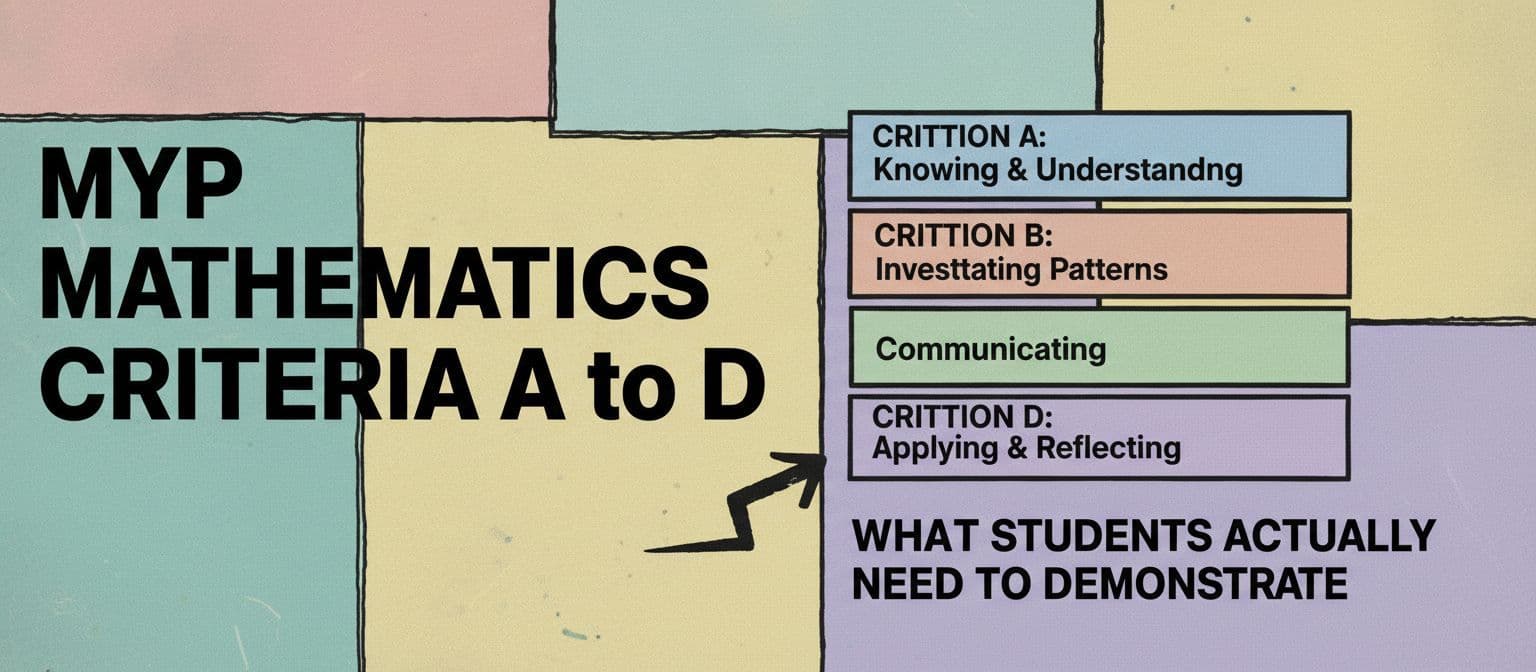
MYP Mathematics is not designed to assess only whether students can reach the correct answer.
Students are expected to know mathematics, investigate relationships, communicate reasoning and apply mathematics in meaningful contexts. That is why the MYP Mathematics framework uses four equally weighted assessment criteria:
- Criterion A: Knowing and understanding
- Criterion B: Investigating patterns
- Criterion C: Communicating
- Criterion D: Applying mathematics in real life contexts
According to the official IB MYP Mathematics subject brief:
“Each mathematics objective corresponds to one of four equally weighted assessment criteria.”
This matters because procedural fluency is only one part of mathematical achievement in the MYP.
A student may calculate accurately but struggle to select a method independently. Another may discover the right relationship but fail to justify it. A third may complete the mathematics correctly without explaining whether the answer makes sense in the real-world context.
The four criteria make those differences visible.
A recent Curriculum Compass article from Koncepts summarises the issue simply:
“MYP Math has four criteria. They are equally weighted.”
The more useful question for a Mathematics department is therefore not whether Criteria A, B, C and D appear somewhere in the assessment calendar.
It is whether students have been explicitly taught what successful performance looks like in all four.
For a wider explanation of how criterion levels connect to MYP reporting, see the Koncepts guide to MYP grading and achievement levels.
Why MYP Mathematics Has Four Criteria
The IB describes MYP Mathematics as a programme that develops inquiry, reasoning, communication and the ability to apply mathematics in real situations.
Students should be able to represent information, explore relationships, solve familiar and unfamiliar problems, communicate mathematical ideas and make decisions using mathematics.
Each criterion reveals a different part of that capability.
Criterion A asks whether students can select and correctly apply mathematical knowledge and techniques.
Criterion B asks whether students can investigate relationships, recognise patterns, formulate general rules and justify why those rules work.
Criterion C asks whether students can communicate mathematical thinking clearly through appropriate notation, terminology and representations.
Criterion D asks whether students can apply mathematics in authentic situations and evaluate whether their conclusions make sense in context.
Correct mathematics matters across all four.
But correctness alone does not provide enough evidence for all four.
Criterion A: Knowing and Understanding
Criterion A is the part of MYP Mathematics that often feels most familiar.
Students select mathematical knowledge and techniques and apply them to solve problems.
The official IB description contains an important phrase:
“both familiar and unfamiliar situations”
Source: IB MYP Mathematics Subject Brief
That distinction should influence task design.
If students practise twenty nearly identical simultaneous-equation questions and then receive a twenty-first version on an assessment, the task can demonstrate procedural fluency.
What it may not reveal is whether students can recognise the mathematics when the representation changes.
For example, a student who has learned linear relationships through textbook graphs might later meet the same mathematics through:
- taxi fares
- temperature conversion
- subscription pricing
- mobile data plans
- two real data sets
The mathematics has not necessarily become harder.
The student now has to recognise which mathematics is relevant before applying it.
That is a stronger test of knowing and understanding.
One Practical Criterion A Fix
Before finalising an assessment, include at least one problem students have not previously seen in exactly the same form.
Do not make the numbers difficult simply to create challenge.
Instead, change the representation, structure or context.
Ask:
Does the student have to recognise the mathematics before applying it?
If the answer is yes, the task is revealing more than rehearsal.
Criterion B: Investigating Patterns
Criterion B is where students move most visibly from following mathematics to investigating mathematics.
The IB describes mathematical investigation as an opportunity for learners to become:
“risk-takers, inquirers and critical thinkers.”
Source: IB MYP Mathematics Subject Brief
Students should not simply notice that a pattern exists.
They need opportunities to discover relationships, formulate general rules and determine whether those rules continue to hold.
IB documentation describing Mathematics objectives includes expectations to:
“prove, or verify and justify, general rules.”
Source: IB Mathematics assessment comparison report
This is where task design can unintentionally create an achievement ceiling.
Consider an investigation that tells students to:
- Complete a table.
- Plot the results.
- Describe the pattern.
- Write the rule.
A student may complete every step correctly.
But almost every important mathematical decision has already been made by the teacher.
IB-related research has highlighted the same issue. When students are not given an opportunity to select their own problem-solving approach, the task can restrict the evidence they are able to demonstrate.
Source: IB Approaches to Teaching research report
The problem is therefore not always that students cannot investigate.
Sometimes the investigation has been designed out of the task.
One Practical Criterion B Fix
Take an existing investigation and remove one unnecessary layer of scaffolding.
Instead of:
Complete the table and describe the pattern.
Try:
Choose a suitable method to investigate the relationship. Develop a general rule, verify it using values beyond your original examples, and justify why the relationship holds.
The content may remain almost identical.
What changes is the amount of mathematical ownership given to the student.
A useful Criterion B sequence is:
Discover → Generalise → Verify → Justify
If a task stops after students recognise a pattern, they may never have an opportunity to demonstrate the more sophisticated reasoning the criterion expects.
For examples of how method choice, complexity, verification and proof affect achievement opportunities, read the detailed Koncepts guide to designing Criterion B tasks for Level 7–8.
Criterion C: Communicating
Criterion C can be underestimated because mathematical communication appears inside almost every other type of mathematical work.
The IB expects students to use:
“appropriate mathematical language and different forms of representation”
when communicating mathematical reasoning and findings.
Source: IB MYP Mathematics Subject Brief
Strong mathematical communication can include:
- Appropriate notation
- Clearly defined variables
- Labelled diagrams
- Accurate graphs
- Logical sequencing
- Relevant mathematical terminology
- Explanations another reader can follow
- Clear conclusions
This is why simply telling students to “show your working” is not enough.
Students need to see what effective mathematical communication actually looks like.
A learner can reach the correct final answer while using inconsistent notation, unexplained jumps or poorly labelled representations.
That is not merely a writing problem.
Communication is part of doing mathematics.
The structure of the official MYP Mathematics eAssessment reinforces this. Criterion C is assessed across several task types rather than being isolated in one communication section:
- Knowing and understanding assesses Criteria A and C.
- Investigating patterns assesses Criteria B and C.
- Applying mathematics in real life contexts assesses Criteria C and D.
Source: IB MYP Mathematics Subject Brief
Criterion C therefore cannot be treated as a separate topic students revise immediately before an assessment.
Clear mathematical communication has to become part of everyday classroom practice.
One Practical Criterion C Fix
Show students two solutions to the same mathematical problem.
Both should reach the correct answer.
The first might contain:
- inconsistent notation
- unexplained jumps
- poorly labelled graphs
- missing definitions
- an unclear conclusion
The second should use precise notation, logical sequencing and a clear explanation.
Then ask:
Which solution communicates the mathematics more effectively, and why?
The criterion immediately becomes more concrete.
“Communicate clearly” is abstract.
Contrasting real mathematical responses gives students visible evidence of what clear communication means.
Criterion D: Applying Mathematics in Real Life Contexts
Criterion D asks students to move mathematics beyond the textbook exercise.
Students need to identify relevant mathematics, apply it to an authentic situation, reach a conclusion and consider whether the result is reasonable.
The official IB framework expects students to apply mathematics to real-life situations and:
“justify whether a solution makes sense in the context of the authentic real-life situation.”
Source: IB Approaches to Teaching research report
The final step is often where classroom tasks become weak.
Students calculate a number and stop.
But mathematically correct calculations can still produce unrealistic conclusions.
A model might give:
4.7 buses0.3 of a person- a negative area
- a growth projection that becomes impossible when extended too far
Criterion D expects students to interpret what the mathematics means in the situation.
This is also why putting a story around a routine calculation does not automatically create a strong Criterion D task.
“The farmer has a rectangular field” may technically describe a real-life context.
But if every contextual detail disappears as soon as students identify two numbers and substitute them into a formula, the context is largely decorative.
A stronger task makes the context affect the mathematical decision.
For example:
- the budget may be limited
- materials may come in fixed dimensions
- the model may depend on assumptions
- the answer may need practical rounding
- two mathematically possible solutions may have different consequences
Now there is something meaningful for the student to evaluate.
One Practical Criterion D Fix
Add this question to the end of a contextual task:
“Is your answer reasonable in this situation? Explain how you know.”
A stronger version might ask:
“Identify one assumption in your mathematical model and explain when the model may stop being useful.”
The calculation is no longer the endpoint.
The student must interpret the mathematics.
The Four Criteria Work Together
A common mistake is to treat Criteria A, B, C and D as four completely separate forms of Mathematics.
Criterion A gets a test.
Criterion B gets an investigation.
Criterion C gets a communication activity.
Criterion D gets a project.
In practice, the criteria overlap.
A strong investigation requires clear communication.
A real-life application still depends on mathematical knowledge.
A Criterion D response can also provide substantial evidence of mathematical communication.
The official eAssessment structure reflects this overlap, particularly because Criterion C appears across all three major task areas.
For classroom planning, this means one criterion can be the main assessment focus while students continue developing skills associated with the others.
What Balanced MYP Mathematics Teaching Looks Like
Balanced teaching does not mean spending exactly 25 percent of every lesson on each criterion.
It means students repeatedly encounter the kinds of thinking each criterion requires before those skills are formally assessed.
Across a unit, students should experience:
- Familiar mathematical procedures
- Unfamiliar mathematical problems
- Pattern investigations
- Opportunities to select methods
- Mathematical justification
- Explicit modelling of mathematical communication
- Authentic contextual problems
- Reflection on whether answers are reasonable
The four MYP Mathematics criteria are equally weighted, but the skills required by them do not develop automatically.
A department that spends most classroom time on Criterion A-style procedural work while assuming investigation, communication and contextual reasoning will emerge naturally risks uneven preparation.
Those skills need deliberate teaching too.
A Simple MYP Mathematics Department Audit
Take the last three assessments used by the department and review them together.
For each assessment, ask the following questions.
Criterion A
Did students ever have to identify which mathematics to use in an unfamiliar situation?
Criterion B
Did students make meaningful decisions about how to investigate?
Were they required to generalise, verify or justify?
Criterion C
Could students demonstrate clear mathematical communication?
Was that expectation explicitly modelled or taught beforehand?
Criterion D
Did the context influence the mathematics?
Did students have to interpret or evaluate whether their answer was reasonable?
Then ask the most important question:
Could a student demonstrate the highest intended achievement level from the task as written?
Assessment tasks create ceilings.
If a task never asks students to justify, sophisticated justification cannot become visible.
If every investigative method is specified, students have little opportunity to demonstrate method selection.
If a real-life task never requires interpretation, students cannot show how effectively they evaluate mathematics in context.
The wording and structure of the task matter almost as much as the mathematics inside it.
How MYP Mathematics eAssessment Uses the Criteria
For schools using MYP eAssessment, the relationship between the criteria becomes especially important.
The official Mathematics subject brief explains that the on-screen examination uses three broad task areas.
Knowing and Understanding
Assesses Criteria A and C.
Investigating Patterns
Assesses Criteria B and C.
Applying Mathematics in Real Life Contexts
Assesses Criteria C and D.
This structure makes one point particularly clear:
Criterion C is everywhere.
Students need sustained practice explaining mathematical decisions, selecting representations and constructing reasoning another person can follow.
The same is true for unfamiliar problems, investigations and contextual evaluation.
These should be normal features of MYP Mathematics teaching rather than skills introduced immediately before eAssessment.
Read the official structure in the MYP Mathematics subject brief.
Use the Rubric Before the Assessment
A rubric is much more useful when students understand it before they submit their work.
For Criterion B, students need to understand the difference between recognising a pattern and justifying a general relationship.
For Criterion C, they need examples of coherent mathematical communication.
For Criterion D, they need to understand that reaching the correct numerical result may not complete the task.
Rubrics become developmental when teachers use them during:
- modelling
- task planning
- peer discussion
- self-assessment
- revision
They become far less useful when students first examine them after an achievement level has already been awarded.
The Koncepts MYP Rubric Generator allows teachers to upload or paste a task, select relevant MYP criteria and create task-specific descriptors across achievement levels 1 to 8.
Every descriptor remains editable by the teacher.
The important point is not simply generating a rubric faster.
It is making the relationship between the task, criterion and required evidence visible before students begin.
For a fuller walkthrough, see the Koncepts guide to building MYP assessments and task-specific rubrics.
Build Assessments Around Criteria, Not Difficulty Labels
An assessment generator that produces only “easy”, “medium” and “hard” Mathematics questions misses an important part of MYP assessment.
Teachers need to know which criterion a task is intended to reveal.
They also need to check whether the task provides enough opportunity for students to demonstrate the intended strands and achievement levels.
The Koncepts MYP Assessment Generator allows teachers to choose the MYP year, subject, criteria and target achievement levels, then review generated questions, rubrics, markschemes and criterion coverage.
Every part remains editable before assignment.
This can also make departmental moderation more focused.
Instead of asking only:
“Is this question hard enough?”
Ask:
- Which criterion does this question assess?
- Which strand becomes visible?
- What mathematical decision does the student have to make?
- What evidence would distinguish a developing response from a sophisticated one?
Those questions are much closer to the logic of MYP assessment.
One Change for Every Criterion This Term
Departments do not need to redesign the entire Mathematics curriculum at once.
Start with four changes.
Criterion A
Include one unfamiliar problem using mathematics students already know.
Criterion B
Remove one layer of unnecessary guidance and require verification or justification.
Criterion C
Show students contrasting examples of weak and strong mathematical communication.
Criterion D
Require students to judge whether their answer makes sense in the context.
None of these changes requires another syllabus topic.
They change what students are asked to do with the mathematics they already know.
The Task Determines What Students Can Show
MYP Mathematics is deliberately broader than procedural accuracy.
Students are expected to know mathematics, investigate mathematics, communicate mathematics and apply mathematics.
That balance is reflected in the four equally weighted assessment criteria.
A student cannot demonstrate sophisticated reasoning if the task asks only for an answer.
They cannot demonstrate independent investigation if every step has already been selected.
They cannot show effective mathematical communication if they have never been shown what effective communication looks like.
They cannot evaluate mathematics in context if the context disappears as soon as the calculation begins.
The Curriculum Compass article expresses the task-design principle clearly:
“The ceiling is almost always in the task, not in the student.”
That does not mean every low achievement level is caused by poor task design.
Student knowledge, preparation and many other factors still matter.
But before asking why a student did not reach a higher achievement level, teachers should check whether the assessment genuinely gave them an opportunity to demonstrate it.
Explore the Koncepts MYP teacher workspace for criterion-aligned unit planning, assessments, rubrics and feedback.