If an MYP report shows a 6 for Criterion A, a 7 for Criterion B, and then a final subject grade of 6, it can feel like two grading systems are being used. In practice, that is close to what is happening.
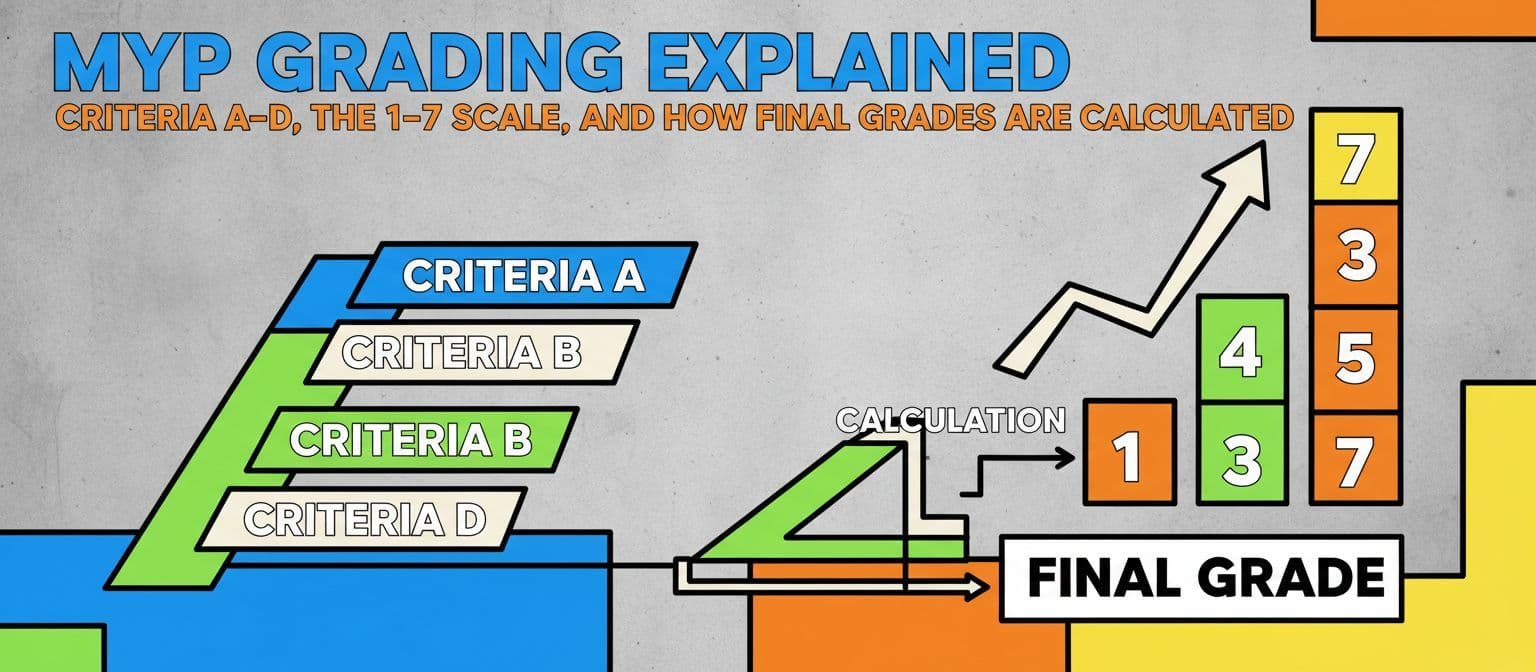
The MYP grading scale works in stages. Students are assessed against four subject criteria, labelled A, B, C, and D. Each criterion can reach an achievement level from 0 to 8. Those four levels can then be combined into a total out of 32 and converted into a final grade from 1 to 7 for school reporting.
The simplest way to remember it is:
Criterion levels from 0 to 8 → total out of 32 → final grade from 1 to 7.
One distinction matters from the beginning. This calculation is commonly used for school based MYP reporting. Official MYP eAssessment results are also reported from 1 to 7, but the IB sets boundaries for those external assessments. A school report grade and an official eAssessment grade should therefore not be treated as identical calculations.
How Are MYP Students Graded?
MYP assessment is criterion based. Students are measured against defined expectations rather than ranked against classmates.
Every MYP subject group uses four criteria, always identified as A, B, C, and D. What those criteria assess changes by subject. Science, mathematics, language acquisition, and individuals and societies do not measure exactly the same skills.
This is why an MYP achievement level is not a percentage. A level 6 does not mean 60 percent. It means the student's work best matches the achievement description associated with that level.
Step 1: Each Criterion Is Assessed From 0 to 8
Each criterion has a maximum achievement level of 8. The levels are organised into bands of 1 to 2, 3 to 4, 5 to 6, and 7 to 8. A level of 0 can be awarded when the work does not reach a standard described by the criterion.
Teachers use the subject criteria and strands to decide which level best represents the evidence a student has produced.
This is important when looking at several scores from the same criterion. If a student receives levels of 3, 5, and 7 for Criterion B across different tasks, the final criterion level is not automatically the arithmetic average. Teachers consider the available evidence and determine the level that best represents achievement according to the school's assessment policy.
For students, that makes the criterion feedback more useful than the number alone. Instead of asking only how to move from a 5 to a 6, ask which strand is preventing the response from reaching the next band.
Step 2: Add the Four Criteria for a Total Out of 32
Once final achievement levels are determined for Criteria A, B, C, and D, they are added together.
8 + 8 + 8 + 8 = 32
Consider this example:
| Criterion | Achievement level |
|---|---|
| Criterion A | 6 |
| Criterion B | 7 |
| Criterion C | 5 |
| Criterion D | 6 |
| Total | 24 out of 32 |
The student has not earned a final grade of 24. The 24 is the combined criterion total. It must still be converted to the final MYP 1 to 7 scale.
Step 3: Convert the Total Into a Final Grade From 1 to 7
A commonly used MYP general boundary table for school reporting is:
| Total criterion achievement | Final MYP grade |
|---|---|
| 1 to 5 | 1 |
| 6 to 9 | 2 |
| 10 to 14 | 3 |
| 15 to 18 | 4 |
| 19 to 23 | 5 |
| 24 to 27 | 6 |
| 28 to 32 | 7 |
In our example:
6 + 7 + 5 + 6 = 24
A total of 24 falls within the 24 to 27 range, so the final reported grade is 6.
This also explains why one extra criterion point may not immediately change the final grade. If Criterion C rises from 5 to 6, the total becomes 25. That is real progress, but 25 still sits inside the Grade 6 range. To reach Grade 7 using this table, the total must reach at least 28.
Schools should follow their current reporting policies, and official eAssessment results should be interpreted using the boundaries applicable to the relevant assessment.
What Do Final MYP Grades Mean?
The 1 to 7 grade summarises achievement across the subject.
A 7 represents the highest overall achievement, with consistently strong understanding, application, and independence.
A 6 represents strong achievement across the criteria, usually with only limited gaps.
A 5 represents generally good achievement, although some criteria or strands may still need development.
A 4 reflects a developing but sound level of achievement, with stronger performance in familiar contexts than in more complex ones.
Grades 1 to 3 indicate more limited evidence against the subject objectives and should be read alongside the individual criterion levels to understand what needs attention.
If you want to interpret a result in context, What Is a Good MYP Score? looks more closely at what different MYP scores can mean for students.
The MYP Certificate and the Maximum Score of 56
The calculation is different when people refer to the official IB MYP certificate.
According to the International Baccalaureate's official grading and awards guidance, the maximum certificate score is 56.
The reason is straightforward. Eight required eAssessment results can each contribute a grade from 1 to 7.
8 components × maximum grade 7 = 56 points
To be eligible for the MYP certificate, a candidate must achieve at least 28 points overall and at least a Grade 3 in each required eAssessment component. Candidates must also meet the relevant programme requirements, including the school's expectations for service as action.
This 56 point certificate total is not created by adding classroom criterion scores. It is calculated from the eight final eAssessment grades.
Not every MYP student necessarily pursues the full IB MYP certificate. Schools may deliver the MYP without every student completing all the optional eAssessments required for that award, so families should confirm the pathway used by their school.
How MYP Grades Compare With IB DP Grades
MYP and the Diploma Programme both report subject grades from 1 to 7, but there is no direct mathematical conversion between them.
In MYP school reporting, achievement is built through four subject criteria and can be converted from a total out of 32. In the Diploma Programme, subject grades come from weighted assessment components, such as examinations and internal assessment, followed by subject grade boundaries.
For the full DP mechanics, read How IB Grades Are Calculated.
The more useful connection between MYP and DP is skill development. MYP teaches students to read criteria, respond to command terms, justify ideas, analyse evidence, communicate clearly, and improve through feedback. Those habits remain valuable when DP assessments demand deeper subject knowledge and stronger performance under examination conditions.
A MYP 7 does not guarantee a DP 7. Likewise, a MYP 4 or 5 does not place a ceiling on future DP performance.
How to Use MYP Grades to Improve
The final grade tells you where you stand overall. The criterion pattern tells you what to do next.
Suppose a student receives:
A: 7, B: 7, C: 5, D: 5
The total is 24, which gives a final Grade 6 using the table above.
If the student focuses only on the final 6, the instruction to "get a 7" is too vague. The individual scores show a clearer route. Criteria C and D are the main opportunities. Raising both from 5 to 7 would take the total from 24 to 28, reaching the Grade 7 boundary in this example.
A useful improvement process is:
- Identify the weakest criterion.
- Read the relevant strands and teacher feedback.
- Compare the current response with the next achievement band.
- Practise the command terms required at that level.
- Improve the quality of the response, not simply its length.
- Check whether the same weakness appears across several tasks.
For written assessments, How to Structure MYP Answers explains how to turn criterion expectations into clearer, more effective responses.
Common MYP Grading Questions
Is MYP Grading Out of 8 or Out of 7?
Both numbers are used for different purposes. Individual criteria are assessed from 0 to 8. The final subject grade is reported from 1 to 7.
Does a Level 6 Mean 60 Percent?
No. Achievement levels are based on descriptors, not percentages.
Does a Student Need 28 Out of 32 for a Grade 7?
Using the general school reporting table shown above, yes. A total from 28 to 32 converts to Grade 7. Official eAssessment results should use the boundaries applicable to that assessment.
What Is the Passing Grade in MYP?
For ordinary school reporting, families should use the school's progression and reporting policy rather than assume one universal pass mark. For the official IB MYP certificate, students need at least Grade 3 in each required eAssessment component and at least 28 points overall.
Final Takeaway
MYP grading becomes much easier once you separate the three numbers.
0 to 8 shows achievement in one criterion.
0 to 32 shows combined achievement across Criteria A, B, C, and D.
1 to 7 shows the final subject grade.
The final grade gives a useful summary, but the criterion levels are what make the system actionable. They show exactly where a student is strongest and where the next improvement can come from.
If you want practice built around MYP criteria, achievement levels, and the way MYP questions actually assess understanding, start studying with Koncepts.