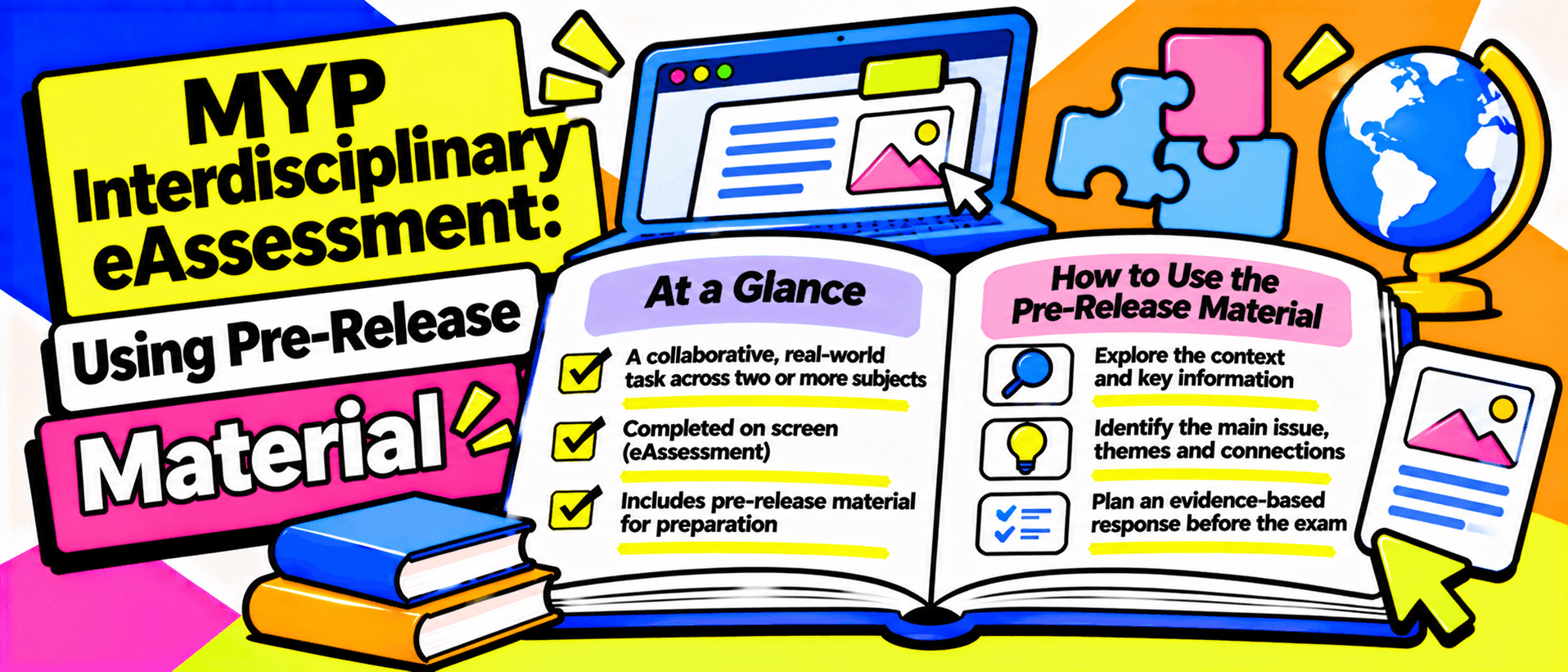
You have received your MYP interdisciplinary eAssessment pre-release material. It contains articles, images, data or videos related to a particular global context.
You read everything, highlight important information and make revision notes.
But what should you actually do with those notes?
Should you memorise the sources? Research every connected topic? Prepare an essay in advance? How do you combine two subjects in a way that demonstrates genuine interdisciplinary understanding?
These questions appeared in an April 2026 r/IBMYP discussion, where students preparing for the May eAssessments exchanged advice about interdisciplinary learning.
Some students understood the individual subjects but were unsure how to connect them in their examination responses.
The essential principle is that interdisciplinary learning is not simply writing about two subjects. It means combining their knowledge and methods to develop an understanding that neither subject could produce as effectively alone.
This guide explains how to analyse pre-release materials, evaluate sources, connect disciplinary perspectives and construct an original interdisciplinary response.
What Is the MYP Interdisciplinary eAssessment?
The International Baccalaureate's MYP interdisciplinary learning curriculum defines interdisciplinary learning as integrating knowledge and modes of thinking from two or more disciplines.
Students use these connections to explain phenomena, investigate problems, create products or develop new understanding.
In MYP 5, interdisciplinary learning is assessed through a two-hour on-screen examination for students registered for the relevant eAssessment.
The examination is part of the requirements for the full MYP Certificate.
| Examination detail | Official framework |
|---|---|
| Assessment | On-screen interdisciplinary examination |
| Duration | 2 hours |
| Number of main tasks | Two |
| Maximum marks | 36 |
| Assessment focus | Evaluating, synthesizing and reflecting |
| Pre-release material | Published approximately six weeks before the examination |
| Selected disciplines | Announced alongside the pre-release material |
These details are outlined in the official MYP Interdisciplinary Learning subject brief.
The examination is not intended to test how much unrelated subject content students can memorise.
It assesses how effectively students connect and apply disciplinary understanding to real-world issues.
When Is the Pre-Release Material Published?
The IB's official eAssessment preparation guidance states that interdisciplinary pre-release material is provided approximately six weeks before the examination.
It is published through the password-protected IB Programme Resource Centre.
For the standard examination calendar, materials become available around:
| Examination session | Pre-release availability |
|---|---|
| May | 1 April |
| November | 1 October |
The exact arrangements should be confirmed through your MYP coordinator.
The material may include multimedia stimuli and case studies related to the session's prescribed global context.
The IB also announces the selected subject groups at the same time.
Do not assume that the subjects, sources or question topics used in an earlier session will be repeated.
The preparation process should begin with your session's official material.
Understand the Three Interdisciplinary Assessment Criteria
MYP interdisciplinary learning uses three equally weighted criteria.
| Criterion | Official name | Main expectation |
|---|---|---|
| A | Evaluating | Analyse and evaluate how different disciplines contribute to understanding an issue |
| B | Synthesizing | Integrate disciplinary knowledge to address a problem or develop new understanding |
| C | Reflecting | Examine how interdisciplinary understanding develops and changes |
In classroom assessment, each criterion uses achievement levels from 0 to 8.
The on-screen examination uses a separate 36-mark blueprint, with 12 marks associated with each criterion.
The two main examination tasks assess evaluation and synthesis, while reflection is incorporated into the appropriate task.
The official subject brief explains these expectations.
The most important distinction is between evaluating an interdisciplinary approach and creating your own interdisciplinary response.
Both require more than summarising the supplied material.
Step 1: Identify the Global Context
Each MYP eAssessment session has a prescribed global context.
The IB identifies six possible global contexts:
- Identities and relationships.
- Orientation in space and time.
- Personal and cultural expression.
- Scientific and technical innovation.
- Globalization and sustainability.
- Fairness and development.
The global context helps connect individual sources to broader real-world questions.
For example, a source about urban heat could relate to globalization and sustainability through environmental planning and resource management.
The same topic could be approached through fairness and development if the emphasis were unequal access to safe public spaces.
However, the examination requires you to use the actual context prescribed for your session.
Do not prepare every global context as though all six will appear in the same paper.
Step 2: Create a Source Analysis Table
When you first receive the pre-release material, avoid writing a lengthy summary of every paragraph.
Instead, identify the most useful information in each source.
| Source feature | Question to ask |
|---|---|
| Main claim | What is the source trying to communicate? |
| Evidence | What facts, examples or data support its claim? |
| Perspective | Whose viewpoint does it represent? |
| Disciplinary connection | Which subject's methods or concepts help explain it? |
| Limitation | What information is missing or uncertain? |
| Connection | How does this source relate to another source? |
This produces a working research document rather than a collection of copied notes.
A short table containing meaningful observations can be more useful than several pages of highlighted material.
You should also distinguish what the source actually demonstrates from what you infer.
If a graph shows a relationship between two variables, it does not automatically establish causation.
Original Practice Stimulus: A School Heat Problem
Consider the following entirely fictional practice scenario.
A school wants to redesign its outdoor courtyard because students find the area uncomfortable during hot afternoons.
The interdisciplinary focus combines Sciences and Individuals and Societies.
For illustration, the global context is globalization and sustainability.
This scenario and all numerical evidence below are original teaching materials. They are not official IB pre-release resources or predictions of a future examination.
Source A: Surface Temperature Measurements
Students recorded temperatures from paved courtyard surfaces during three comparable afternoon observations.
| Surface | Illustrative average temperature |
|---|---|
| Unshaded pavement | 45°C |
| Shaded pavement | 33°C |
The measurements suggest a difference of 12°C between the observed surfaces.
However, surface temperature is not the same as air temperature or human thermal comfort.
The source therefore provides useful evidence but cannot establish the complete effect of a proposed intervention.
Source B: Student Survey
A fictional survey of 48 students found that 29 respondents avoided the courtyard during lunch because they perceived insufficient shade.
The survey suggests that some students experience the courtyard as uncomfortable.
However, the findings may be affected by participant selection, the wording of the questions and the small sample.
Source C: School Planning Proposal
A fictional planning committee proposes two options:
- Construct a fixed shade canopy.
- Introduce trees and additional seating.
The committee wants a solution that improves comfort while considering maintenance, accessibility and long-term environmental impact.
The challenge is to integrate physical evidence with the needs of the school community.
Step 3: Identify What Each Discipline Contributes
Begin by analysing the problem from each disciplinary perspective.
| Discipline | Knowledge or method | Contribution |
|---|---|---|
| Sciences | Heat transfer, surface temperature and experimental measurements | Helps explain why exposed surfaces may become hotter |
| Individuals and Societies | Human behaviour, spatial use, access and decision-making | Helps explain who uses the space and whether proposed changes address their needs |
A science-based investigation could compare different materials and shade conditions.
An Individuals and Societies investigation could examine the relationship between courtyard design, student behaviour and equitable access.
Each approach contributes useful information.
However, the school cannot design a suitable intervention through surface measurements alone.
It also needs to understand how the space is used.
Similarly, student preferences alone cannot establish the physical effectiveness of a proposed cooling strategy.
This is where interdisciplinary reasoning becomes necessary.
Step 4: Move From Description to Synthesis
A descriptive answer might say:
Science helps us understand temperature. Individuals and Societies helps us understand students. Both are important for improving the courtyard.
The statement identifies two subjects but does not meaningfully combine them.
A stronger interdisciplinary response would explain:
The surface-temperature measurements suggest that shade may reduce heat absorbed by exposed pavement, while the student survey identifies a practical reason to prioritise shaded areas during lunch. Combining these findings suggests that the school should investigate shade placement in the areas students use most frequently. However, the existing data do not establish which intervention would provide the greatest overall improvement in comfort, so further measurements and consultation would be necessary.
The second response demonstrates a new understanding.
It uses scientific measurements to investigate an environmental condition and social evidence to identify where an intervention might be most valuable.
The disciplines inform one shared decision rather than appearing as two separate paragraphs.
Step 5: Evaluate the Evidence and Its Limitations
Criterion A requires students to examine the contribution of different disciplines critically.
In the courtyard example, the scientific measurements provide quantitative evidence.
However, they involve only a small number of observations and do not directly measure the experience of people using the space.
The survey offers information about perceptions and behaviour.
However, reported discomfort is subjective, and the sample may not represent the entire school community.
Neither source is necessarily useless because of these limitations.
The important question is how much confidence each source supports.
An effective interdisciplinary evaluation might explain that physical measurements improve understanding of environmental conditions, while surveys reveal whether those conditions matter to the intended users.
Together, the sources can guide further investigation.
But they do not justify claiming that one design will definitely solve the problem.
Step 6: Develop an Original Interdisciplinary Solution
Now consider an original practice task:
"Propose an approach the school could use to improve courtyard conditions. Explain how knowledge from both disciplines informs your solution."
A developed response might recommend:
The school should begin with a short pilot that introduces temporary shade in a frequently used section of the courtyard. Science students could record surface and air temperatures under comparable conditions, while Individuals and Societies students could investigate changes in courtyard use and gather feedback from different student groups.
The school could then compare the physical results with the reported experiences of users. This would help determine whether the intervention improves comfort in practice and whether further changes are needed for accessibility or equitable use.
The proposed solution integrates scientific investigation with social research.
It also creates a process for evaluating results rather than relying on assumptions.
This is an illustrative response, not an officially marked exemplar.
Step 7: Reflect on How Your Understanding Changed
Criterion C focuses on reflecting on the development of interdisciplinary understanding.
Weak reflection often describes activities without explaining learning.
For example:
I learned about surface temperatures and student surveys. Both subjects were useful.
A more meaningful reflection identifies a change in understanding:
Initially, I assumed that the area with the highest surface temperature should receive shade first. After considering how students use different parts of the courtyard, I realised that physical measurements alone could not establish where an intervention would have the greatest practical benefit. Integrating the two disciplines changed my approach from simply identifying the hottest surface to considering environmental conditions and user needs together.
This reflection explains how disciplinary integration influenced the proposed solution.
It also recognises what remains uncertain.
The strongest reflections examine how understanding evolved, not simply whether the task was enjoyable.
How to Prepare During the Six-Week Pre-Release Period
Use the available preparation period deliberately.
| Period | Suggested focus |
|---|---|
| Week 1 | Read the official sources and identify central issues |
| Week 2 | Examine relevant concepts and methods from each selected discipline |
| Week 3 | Compare source perspectives, evidence and limitations |
| Week 4 | Practise questions requiring integration and synthesis |
| Week 5 | Complete timed responses using unfamiliar practice material |
| Week 6 | Review criteria, refine reasoning and practise reflection |
This is a suggested study schedule, not a requirement imposed by the IB.
Your preparation should remain flexible enough to respond to the material and examination tasks actually provided.
Avoid devoting the entire period to memorising one predicted essay.
The assessment may require you to apply the sources in ways you have not rehearsed.
How to Manage the Two-Hour Examination
The interdisciplinary examination contains two main tasks.
A practical starting strategy is to allocate approximately one hour to each.
However, the mark distribution and specific demands of the tasks should guide your final time allocation.
Before answering, identify the command term.
Analyse: Explain relationships, contributions and significance.
Evaluate: Consider strengths, limitations and the value of an approach.
Synthesize: Combine knowledge to create a new explanation, proposal or solution.
Reflect: Explain how your thinking or understanding developed.
The task may involve written material, multimedia or interactive features.
Use the official familiarisation materials provided through your school to practise navigating the examination interface.
Common MYP IDU eAssessment Mistakes
Students should avoid several habits.
Memorising the pre-release material without analysing it. Knowing the content does not establish interdisciplinary understanding.
Writing separately about two subjects. The response must demonstrate meaningful integration.
Ignoring source limitations. Evaluate what the evidence can and cannot establish.
Using subject terminology without explaining its relevance. Concepts should support a specific argument.
Making unsupported predictions about examination questions. The pre-release material provides context, not a complete advance copy of the examination.
Writing generic reflections. Explain how combining the disciplines influenced your understanding.
The IB's Understanding eAssessment guidance emphasises the application of understanding in complex and unfamiliar situations.
That is why flexible reasoning matters more than prepared answers.
Where Can You Find Official Practice Materials?
The most reliable source is your school's MYP coordinator or relevant teachers.
The IB Programme Resource Centre provides authorised schools with examination materials, including pre-release resources, specimen examinations, subject guides and support documents.
The official eAssessment preparation page also explains the role of examination familiarisation activities.
Use these materials to understand task types, assessment criteria and the digital examination environment.
Previous examination material can support practice, but it should not be treated as evidence that the same subject pairing or source topic will appear again.
Final MYP Interdisciplinary eAssessment Checklist
Before your examination, confirm that you can:
- Explain the prescribed global context.
- Identify the selected subject groups and their relevant concepts.
- Summarise the central claims of the pre-release sources.
- Evaluate evidence, perspectives and limitations.
- Explain what each discipline contributes to understanding an issue.
- Combine disciplinary knowledge into a new explanation or solution.
- Justify proposed actions using relevant evidence.
- Reflect on how interdisciplinary thinking changes understanding.
- Respond to unfamiliar tasks without relying on memorised answers.
Final Verdict: How Should You Use Pre-Release Material?
The MYP interdisciplinary eAssessment rewards the ability to connect knowledge, not simply remember information.
The pre-release material gives you time to understand an issue, investigate relevant disciplinary perspectives and explore how different forms of evidence relate to one another.
Effective preparation involves examining each source critically, identifying what the selected disciplines contribute and practising the creation of new explanations or solutions.
The strongest responses demonstrate why the combined understanding is more useful than either disciplinary perspective alone.
Instead of asking only, "What does each source tell me?", ask:
"What can I understand, explain or propose by combining this evidence that I could not achieve through one subject alone?"
That question captures the central purpose of interdisciplinary learning.
For definitive guidance, consult the IB MYP interdisciplinary learning curriculum, the official subject brief and the IB eAssessment preparation guidance.
Table of contents
Share
Related reading
- MYP eAssessment 30-Day Study PlanFollow this 30 day MYP eAssessment study plan with daily drills, timed practice, weekly checks and a printable planner. Start preparing smarter today.
- MYP eAssessment: The Complete Teacher's GuideMaster MYP eAssessment with subject formats, on-screen exams, 2026 schedules, cohort prep strategies, and smarter practice with Koncepts for teachers.
- MYP Past Papers & eAssessment Practice: Where to Find Them + How to PracticeLooking for MYP past papers? Learn where to find official and trusted practice resources, master eAssessment, and prepare smarter with Koncepts.
- Master the New Interdisciplinary EE with ConfidenceLearn how to confidently supervise the new Interdisciplinary Extended Essay with practical strategies that help students succeed. Read now.