You have been completing CAS experiences, uploading reflections and participating in school activities. Then your CAS coordinator mentions something different: a compulsory CAS project lasting at least one month.
Suddenly, you have questions.
Does the IB still require a CAS project? Can you organise one event and count the preparation time? Must you work with other students? Does your project need to include creativity, activity and service?
These concerns are common among Diploma Programme students.
In a December 2025 r/IBO discussion, a student at a newly established IB school asked whether the project was still compulsory and how to complete one with limited time.
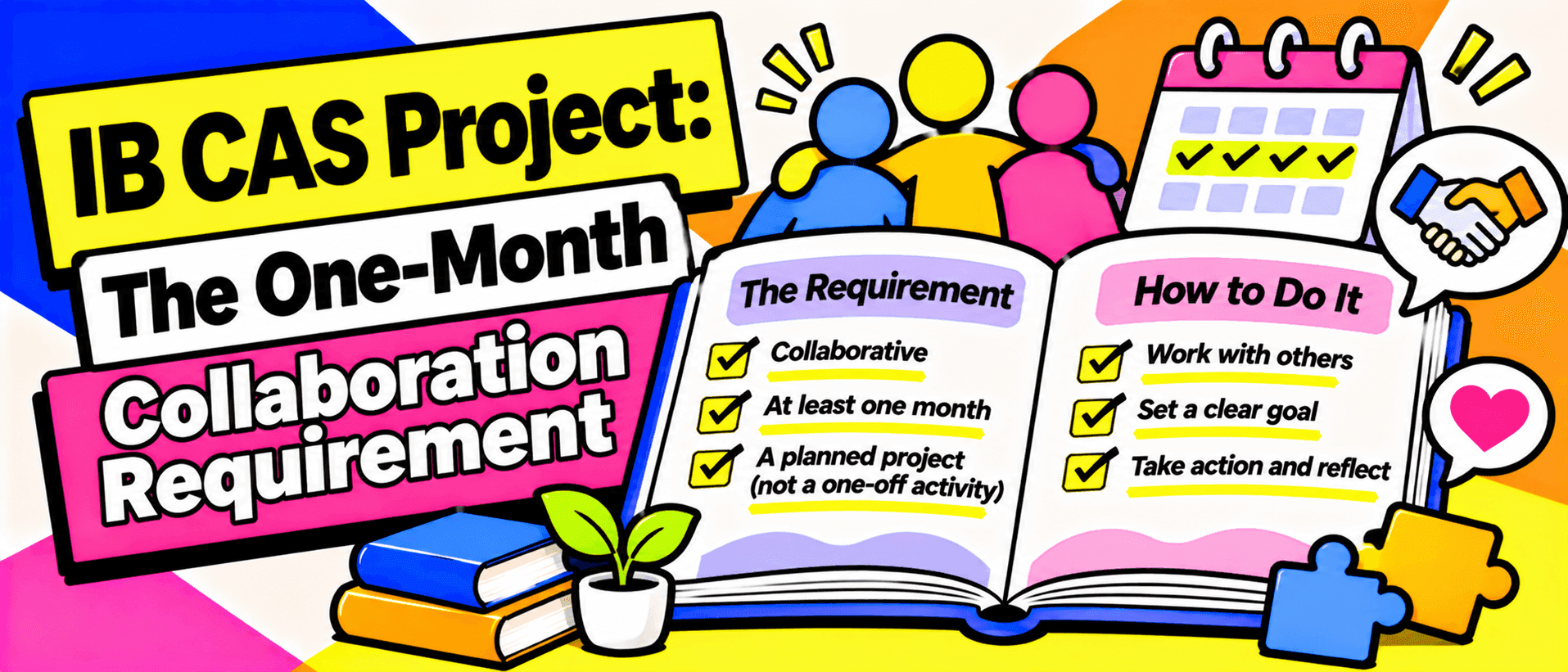
The official requirement is clear: every Diploma Programme student must participate in at least one collaborative CAS project lasting a minimum of one month.
However, that does not mean organising an expensive event, completing hundreds of service hours or creating a complicated initiative.
This guide explains the official IB CAS project requirements, the difference between a project and an experience, the five CAS stages and how to plan something realistic.
Is the CAS Project Compulsory in the IB Diploma?
Yes. The CAS project remains a compulsory part of Creativity, Activity, Service.
According to the official IB CAS overview, CAS is one of the three essential elements of the Diploma Programme core, alongside Theory of Knowledge and the Extended Essay.
Every Diploma Programme student must complete CAS.
Although CAS is not formally graded, students must demonstrate achievement of the seven CAS learning outcomes.
The IB CAS subject brief explicitly requires students to complete at least one CAS project.
Therefore, completing individual CAS experiences does not remove the project requirement.
A student who participates in sports, volunteering and creative activities throughout the programme still needs a qualifying collaborative project.
What Are the Official IB CAS Project Requirements?
The IB defines a CAS project as a collaborative sequence of CAS experiences extending over at least one month.
This definition contains three essential requirements.
| Requirement | What it means |
|---|---|
| Collaboration | Students work meaningfully with others toward a shared objective |
| Minimum duration | The connected project activities extend over at least one month |
| Sequential experiences | The project involves purposeful stages rather than unrelated activities |
The official IB CAS projects page also emphasises personal challenge, initiative, thoughtful planning and reflection.
Importantly, the IB does not prescribe one standard project that every student must complete.
Projects should reflect students' interests, abilities and opportunities for growth.
Your school may establish additional requirements concerning proposals, approval, evidence and deadlines.
Those procedures should be distinguished from the core IB rules.
CAS Project vs CAS Experience: What's the Difference?
A CAS experience can be a single event or an extended activity involving creativity, activity or service.
A CAS project is more specific. It requires sustained collaboration across a connected sequence of experiences.
| Activity | CAS experience | Potential CAS project |
|---|---|---|
| Creativity | Attend a painting workshop | Collaboratively plan, create and exhibit a mural over several weeks |
| Activity | Participate in a football match | Organise and run a sustained community sports programme |
| Service | Volunteer at one tutoring session | Develop and deliver a month-long peer tutoring initiative |
| Environment | Participate in a clean-up event | Coordinate a waste-reduction initiative involving planning, action and monitoring |
The examples in the project column are possible project designs, not automatically approved activities.
Each would need meaningful collaboration, an appropriate timeline and genuine involvement.
The difference is not simply the size of the activity. It is the sustained, collaborative process behind it.
Does a CAS Project Have to Last One Month?
Yes. The minimum duration is an official requirement, not merely a school recommendation.
The IB subject brief states that a CAS project lasts at least one month.
However, this does not require daily work.
A student group might hold planning meetings during the first week, prepare resources during the second, implement activities during the following weeks and evaluate results at the end.
The work can take place on different days, provided the project demonstrates sustained involvement.
Can a one-day event count?
A single event is not automatically a month-long project.
However, a one-day exhibition, performance or community workshop could be the culmination of several weeks of genuine collaborative planning and preparation.
For example, a student group might spend five weeks researching a community issue, producing educational materials, coordinating participants and organising an awareness event.
The final event may last only one day, while the complete project extends across the required period.
The planning activities must be genuine.
Simply recording a start date one month before an event, without meaningful activity during that period, does not establish sustained involvement.
Does the CAS Project Need All Three Strands?
No. This is another common misconception.
The IB CAS projects guidance confirms that a project may involve one strand, two strands or all three.
The strands are:
Creativity: Exploring ideas and developing original or interpretive work.
Activity: Participating in physical exertion that contributes to a healthy lifestyle.
Service: Voluntary, unpaid engagement responding to an authentic community need.
A student team creating a theatrical production could complete a creativity-focused project.
A group developing a sustained sports programme could focus on activity.
A tutoring initiative responding to an identified educational need could focus on service.
Combining multiple strands is possible, but it does not automatically make a project more successful.
Select the strand or combination that accurately reflects the work.
What Counts as Genuine Collaboration?
Collaboration means more than placing several names on a project proposal.
The participants should contribute to a shared goal through meaningful involvement.
Consider two situations.
Example A: A student plans an entire event independently while friends attend on the final day.
Example B: A student group identifies a common objective, divides responsibilities, makes decisions together and responds collectively to challenges.
The second example more clearly demonstrates collaboration.
Team members do not need identical responsibilities.
One student might coordinate communication, another manage logistics and another develop materials.
However, every participant should contribute meaningfully and be able to reflect on their role.
Working with appropriate community partners may also create opportunities for collaboration, subject to school approval.
Before beginning, agree on the responsibilities, communication methods and expected contributions of everyone involved.
Understand the Five CAS Project Stages
The IB identifies five CAS stages that support purposeful experiential learning.
These are investigation, preparation, action, reflection and demonstration.
| Stage | Purpose | Example |
|---|---|---|
| Investigation | Identify a meaningful need or opportunity | Discover that students lack access to affordable revision books |
| Preparation | Establish goals, resources and responsibilities | Develop a book exchange plan |
| Action | Implement the activities | Collect, organise and distribute books |
| Reflection | Evaluate experiences and personal learning | Discuss teamwork difficulties and improvements |
| Demonstration | Share outcomes and learning | Present project results to the school community |
These stages should not be treated as five completely separate administrative tasks.
Reflection can occur throughout the project.
For example, students may discover during the action stage that their collection system is not working.
They might revise their approach, document the change and explain how the experience influenced their decisions.
That process demonstrates problem-solving and learning.
The IB CAS subject brief highlights these stages as part of effective experiential learning.
Worked Example: A Five-Week School Book Exchange
Consider an original CAS project idea called Books for Everyone.
A group of four students notices that some classmates struggle to access affordable books.
They decide to organise a school book exchange that allows students to donate suitable books and access materials they need.
The team develops a plan lasting five weeks.
| Week | Activities | Possible evidence |
|---|---|---|
| Week 1 | Investigate demand and discuss the idea with school staff | Survey summary, meeting notes |
| Week 2 | Obtain permissions, assign roles and create communication materials | Project plan, posters |
| Week 3 | Begin collecting and categorising books | Collection records, permitted photographs |
| Week 4 | Organise exchange sessions and gather feedback | Participation records, feedback |
| Week 5 | Evaluate the initiative and share outcomes | Final report, individual reflections |
The project provides opportunities for planning, collaboration, problem-solving and personal growth.
The students may also encounter ethical questions.
For example, requiring every participant to donate a book could exclude students who have none to contribute.
The team might revise the system to ensure more equitable access.
This is an illustrative project design, not an IB-approved project template.
Students should obtain school approval and adapt the plan to their own circumstances.
Five Practical CAS Project Ideas
A successful project does not need a large budget.
Consider these achievable ideas.
| Project | Possible strand | Collaborative activities |
|---|---|---|
| Peer tutoring programme | Service | Identify learning needs, organise sessions and assess feedback |
| Community fitness initiative | Activity | Develop accessible sessions and coordinate participants |
| Collaborative mural | Creativity | Agree on a theme, create designs and produce the artwork |
| School sustainability campaign | Creativity and service | Investigate a problem, develop resources and monitor participation |
| Community garden initiative | Activity and service | Plan planting activities, divide responsibilities and maintain the space |
Choose a project that you can realistically complete alongside your academic responsibilities.
For service projects, establish the community need before deciding what help to provide.
For activities involving children, public spaces or external organisations, obtain appropriate permissions and safeguarding arrangements.
How Many Reflections Does a CAS Project Require?
The one-month requirement and reflection requirements are separate issues.
The IB expects students to reflect meaningfully on CAS experiences and maintain evidence of learning.
However, the public CAS guidance does not establish a universal numerical requirement, such as five reflections per project or one reflection every week.
Schools may introduce their own portfolio procedures.
For example, a school might ask students to submit a planning reflection, progress updates and a final reflection.
These may be useful ways to document learning, but students should not mistake a school's submission schedule for an IB-wide numerical rule.
The quality of reflection matters.
A meaningful reflection explains what happened, why it was challenging, what the student learned and how that learning influenced later actions.
What Does a Strong CAS Reflection Look Like?
Consider the following weak example:
Our project went well. Everyone worked together, and I learned the importance of teamwork.
This identifies a positive experience but provides little evidence of development.
A stronger original example would be:
During our first book collection session, we received several donations that were unsuitable for the exchange. I realised that our instructions were unclear. After discussing the problem with the team, we revised the collection guidelines and introduced a simple checking process. This taught me that effective collaboration requires clear communication and a willingness to adapt when the original plan does not work.
This reflection identifies a challenge, describes the response and explains the learning.
Students should reflect on events that genuinely occurred.
Do not invent challenges or copy example reflections into your portfolio as personal experiences.
What Evidence Should You Keep?
The IB expects students to maintain a CAS portfolio containing evidence of participation and reflection.
Useful records may include:
- An approved project proposal.
- A timeline and agreed team responsibilities.
- Dated notes from planning meetings.
- Materials produced during the project.
- Records of activities and outcomes.
- Feedback from participants or stakeholders.
- Individual reflections and a final evaluation.
Photographs can provide supporting evidence, but they should be collected and shared with appropriate consent.
A portfolio does not become stronger simply by containing more images.
Evidence should demonstrate authentic participation and learning.
The IB CAS subject brief confirms that the portfolio supports CAS completion but is not itself formally graded.
How Does the Project Support the Seven CAS Learning Outcomes?
The wider CAS programme requires students to demonstrate seven learning outcomes.
These concern:
- Recognising strengths and areas for development.
- Undertaking challenges and developing skills.
- Initiating and planning experiences.
- Demonstrating commitment and perseverance.
- Working collaboratively.
- Engaging with issues of global significance.
- Considering the ethics of choices and actions.
Students must provide evidence of achieving each outcome at least once across their CAS programme.
They do not need to demonstrate every learning outcome within a single project.
For example, the book exchange may provide evidence of planning, perseverance, teamwork and ethical decision-making.
Other CAS experiences may provide evidence of outcomes not addressed by that project.
Completion is based on the overall CAS programme, not merely the submission of one project report.
Can You Complete a CAS Project at the Last Minute?
If your CAS deadline is approaching, begin by checking what you have already completed.
You may have participated in a sustained collaborative activity that potentially meets the project requirements.
Discuss the actual evidence with your CAS coordinator before making that judgement.
Do not combine unrelated past experiences simply to create the appearance of one project.
If you have not started a qualifying project, choose a manageable idea and establish a realistic schedule.
An achievable peer tutoring initiative or collaborative creative project may be more practical than organising a large fundraising event.
Remember that CAS projects must not simply duplicate work already used to fulfil another Diploma Programme course requirement.
If your remaining time is shorter than the required month, discuss the situation with your coordinator.
Do not invent dates, activities or documentation.
Final CAS Project Planning Checklist
Before submitting your proposal, confirm the following:
- The project involves at least one CAS strand.
- The objective is meaningful and achievable.
- Collaboration is genuine and responsibilities are clear.
- The connected activities extend over at least one month.
- The project includes planning, implementation and opportunities for reflection.
- Necessary permissions and safety arrangements are in place.
- You have a realistic timeline and access to required resources.
- Your participation and learning can be documented authentically.
- The project has been discussed with your CAS coordinator.
- You understand your school's submission and completion procedures.
Final Verdict: What Makes a CAS Project Valid?
The IB CAS project requirements focus on sustained collaboration, purposeful activity and experiential learning.
Every Diploma Programme student must participate in at least one CAS project lasting a minimum of one month.
The project can focus on creativity, activity, service or a combination of those strands.
It does not require an expensive event, a large organisation or an elaborate final product.
What matters is that students take initiative, contribute meaningfully, respond to challenges and reflect on their development.
A relatively small project can provide valuable learning when it is properly planned and genuinely collaborative.
Choose a realistic goal, work with others, document your involvement and reflect on what changes through the experience.
For authoritative information, consult the IB Creativity, Activity, Service overview, the official CAS projects guidance and the IB CAS subject brief.
Table of contents
Share
Related reading
- MYP Personal Project Guide: Criteria & ExamplesMaster the MYP Personal Project with step by step guidance, examples, criteria, timelines, supervisor tips and report advice. Start stronger with Koncepts.
- IB Diploma Timeline 2026 to 2028: Your Month by Month Survival GuideDiscover the complete IB Diploma timeline for 2026 to 2028 with a month by month roadmap covering EE, TOK, IAs, exams, and deadlines.
- Hardest IB Subjects: What the 2026 Results Really SayExplore the hardest IB subjects using May 2026 grade data. Compare HL results, understand the limits of rankings, and choose subjects with greater confidence.