Introduction
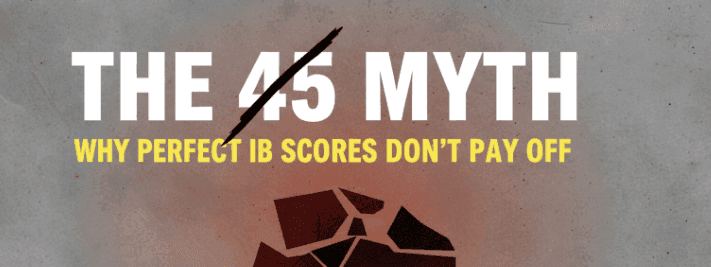
For years, the number 45 has held an almost mythical status in the world of the :contentReference[oaicite:0]{index=0}. It represents perfection. Precision. Academic dominance.
But in 2026, this number is starting to look less like a golden ticket and more like a strategic illusion.
Students across the globe are investing enormous effort chasing that perfect score. Late nights stretch into early mornings. Internal Assessments are rewritten endlessly. Every mark lost feels like a structural crack in a carefully built identity.
Yet a quiet truth is emerging:
The difference between a 42 and a 45 is often far less valuable than students think—while the cost of chasing it has never been higher.
This blog explores why the pursuit of a perfect IB score may actually be a strategic mistake in 2026, and what high-performing students are doing instead.
1. The Illusion of the Perfect Score
A 45/45 score appears to signal absolute academic mastery. On paper, it is the pinnacle. But admissions systems do not operate on symbolic perfection—they operate on thresholds, context, and differentiation.
a) Universities think in bands, not perfection
Top universities rarely distinguish meaningfully between:
- 42 vs 43
- 43 vs 44
- 44 vs 45
These scores often fall within the same evaluation bracket.
Once a student crosses a certain threshold (typically around 40–42), the marginal gain of additional points begins to shrink rapidly.
b) The concept of diminishing returns
In economics, diminishing returns describe a point where additional input yields progressively smaller output.
In IB scoring:
- The first 30 points reflect foundational competence
- The next 10 reflect strong academic ability
- The final 3–5 points demand disproportionate effort for minimal external reward
The system rewards reaching excellence. It does not proportionally reward perfecting it.
2. The Hidden Cost: Burnout and Cognitive Fatigue
Chasing 45 is not just academically demanding—it is psychologically expensive.
a) The perfection loop
Students aiming for 45 often fall into a cycle:
- Rewriting already strong work
- Obsessing over marginal improvements
- Avoiding risk to protect grades
- Equating self-worth with performance
This loop is not about learning. It is about control.
b) Burnout is no longer a side effect—it’s a pattern
In 2026, burnout among IB students is increasingly common due to:
- Continuous assessment pressure
- IA deadlines across subjects
- Competitive peer environments
- Constant performance comparison
The irony is sharp:
Students pushing for perfection often experience a drop in performance due to mental fatigue.
c) Opportunity cost
Every extra hour spent squeezing one more mark out of a subject is an hour not spent on:
- Building extracurricular depth
- Developing unique interests
- Preparing for interviews
- Exploring career clarity
Perfection consumes time. Strategy allocates it.
3. What Universities Actually Value in 2026
The admissions landscape has evolved. Academic scores still matter—but they are no longer the sole differentiator.
a) Threshold-based evaluation
Most top universities use IB scores as an initial filter:
- Meet the requirement → application considered
- Exceed it slightly → marginal benefit
- Far exceed it → minimal additional advantage
Once the threshold is crossed, other factors dominate.
b) Holistic review is now decisive
Universities increasingly focus on:
- Personal essays
- Subject alignment with career goals
- Evidence of intellectual curiosity
- Extracurricular impact
- Leadership and initiative
A student with a 42 and a compelling narrative often stands out more than a 45 with a generic profile.
c) Authenticity over optimization
Admissions teams are becoming more sensitive to overly “optimized” profiles:
- Perfect scores
- Polished but generic essays
- Lack of personal voice
What stands out in 2026 is not flawlessness—it is clarity of identity.
4. The Strategic Mistake: Misallocating Effort
The pursuit of 45 often leads to a critical strategic error:
Over-investing in what is already strong while under-investing in what actually differentiates.
a) Over-optimization of academics
Students spend excessive time:
- Refining answers they already understand
- Memorizing beyond required depth
- Perfecting IA formatting instead of insight
This creates diminishing academic returns.
b) Underdevelopment of profile depth
At the same time, they neglect:
- Building a strong personal narrative
- Engaging deeply with one area of interest
- Creating projects that reflect initiative
In a competitive admissions landscape, this imbalance can be costly.
5. What Top Students Are Doing Differently
High-performing students in 2026 are not abandoning ambition—they are redirecting it.
a) Targeted excellence instead of universal perfection
Instead of aiming for 7s in everything, they:
- Prioritize key subjects aligned with their goals
- Maintain strong but not obsessive performance in others
This creates a balanced yet focused academic profile.
b) Strategic time allocation
They divide effort across:
- Academics (to meet and slightly exceed thresholds)
- Extracurricular depth (to stand out)
- Personal development (to sustain performance)
Their schedule reflects priorities, not pressure.
c) Depth over breadth
Rather than doing many activities superficially, they:
- Go deep into one or two meaningful pursuits
- Build projects, portfolios, or research
- Demonstrate sustained interest over time
This creates narrative coherence.
d) Controlled ambition
They aim high—but not blindly.
Their mindset:
- Maximize outcome, not effort
- Optimize strategy, not just intensity
- Accept that perfection is optional, impact is not
6. The Psychological Shift: From Perfection to Precision
The most important transformation is not academic—it is mental.
a) Redefining success
Instead of:
- “I must get 45”
Top students think:
- “I must build the strongest overall profile possible”
b) Accepting strategic trade-offs
They understand:
- Not every subject needs maximum output
- Not every mark needs to be recovered
- Not every opportunity needs to be taken
They choose deliberately.
c) Building resilience over rigidity
Perfection demands rigidity. Strategy demands adaptability.
In an unpredictable system, adaptability wins.
7. When Does a 45 Actually Matter?
There are specific scenarios where a perfect score can provide an edge:
- Highly competitive scholarship programs
- Extremely selective courses with tight cutoffs
- Situations with otherwise identical profiles
But these are exceptions, not the rule.
For the majority of students:
- The incremental value of 45 over 42–43 is limited
- The cost of achieving it is disproportionately high
8. A Smarter Approach to IB in 2026
Instead of chasing perfection, students should aim for strategic excellence.
Step 1: Define your target range
Set a realistic and competitive score goal (e.g., 40–43).
Step 2: Identify high-impact subjects
Focus more effort on subjects relevant to your future goals.
Step 3: Protect your mental bandwidth
Avoid over-investing in marginal gains.
Step 4: Build a differentiated profile
Invest time in activities, projects, and ideas that reflect who you are.
Step 5: Use effort as a tool, not a reflex
Effort should be directed, not automatic.
Conclusion
The number 45 will always carry symbolic weight. It represents discipline, intelligence, and consistency.
But in 2026, it no longer guarantees a proportionate return.
The IB has evolved. University admissions have evolved. The competitive landscape has evolved.
And in this new environment, the smartest students are not the ones chasing perfection.
They are the ones who understand where perfection stops adding value—and have the confidence to stop there.
Because success in the IB is no longer about proving you can do everything perfectly.
It is about proving you can make the right decisions when it matters most.
Table of contents
Share
Related reading
- IB DP Subject Choices: Maths AA, AI and the Right HLsChoose IB Maths AA or AI and the right HL subjects with current university requirements, real course examples and a practical subject selection checklist.
- Inside the IB November Exam Session Few Students KnowDiscover who takes IB November exams, why this session matters, and when it may be a smarter route for students planning retakes or university entry today.
- How to Craft an IA Introduction That Captivates ExaminersStruggling with your IA intro? Learn how to hook your examiner with a powerful introduction that stands out. Boost your IB scores with this guide.
- How to Write a TOK Essay That Truly Impresses ExaminersStruggling with your TOK essay? Learn proven strategies to impress examiners and boost your IB score. Read this expert guide and start writing smarter today.
- The IB Consistency Trap: Why “Good Every Day” Students Are Losing to “Strategic Sprinters” in 2026Discover why consistency alone isn’t enough in IB and how strategic effort timing helps top students outperform with smarter study and higher scores.
