“Consistency builds habits. Strategy builds scores.”
In the IB world, there’s one golden rule everyone repeats:
“Be consistent. Study every day. Stay balanced.”
It sounds right. It feels disciplined. It’s also quietly misleading.
Because in 2026, a new pattern is emerging:
👉 Students who are consistently good are being outperformed by those who are strategically intense.
Not because they work harder overall.
But because they work harder at the right time.
Welcome to the IB Consistency Trap.
The Myth of Consistency in IB
Let’s be clear:
Consistency is useful.
It builds habits. It prevents chaos.
But here’s the hidden flaw:
IB is not a system that rewards equal effort across time.
It’s a system where:
- Some tasks matter a lot
- Some tasks matter very little
Yet most students treat everything the same.
They:
- Study a bit every day
- Give equal attention to all subjects
- Maintain steady effort
And end up with:
👉 Steady… but average outcomes
Where Marks Actually Come From
Let’s break the illusion.
In IB, your final score is not built equally across all work.
High-impact components include:
- Internal Assessments (IAs)
- Extended Essay (EE)
- Final Exams
Low-impact components:
- Daily homework
- Class participation
- Minor assignments
The reality:
A single IA can influence your grade more than weeks of daily effort.
Yet most students:
- Spend hours perfecting routine work
- Underinvest in high-weight components
That’s not inefficiency.
That’s misallocation.
The Plateau Effect: Why “Always Good” Becomes “Never Great”
If you’re always operating at:
👉 60–70% effort
You rarely produce:
👉 90–100% quality work
This leads to:
- Decent essays
- Safe IAs
- Predictable analysis
But nothing exceptional.
This is the plateau effect.
You’re consistent…
But never pushing into the zone where top marks are created.
How Toppers Allocate Effort Differently
Top IB scorers don’t spread effort evenly.
They concentrate it.
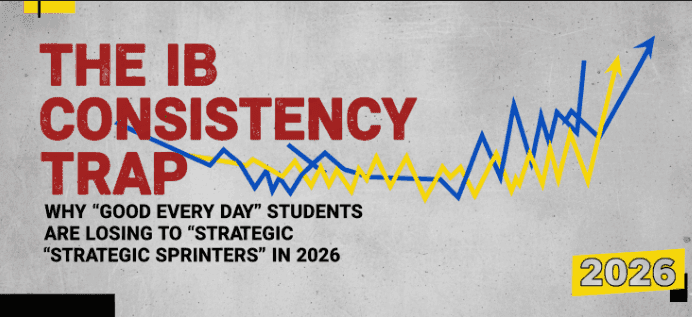
Think of their workflow like a heartbeat:
📉 Low effort → baseline maintenance
📈 High effort → targeted spikes
They don’t aim to be “on” all the time.
They aim to be:
fully on when it matters most
The “Spike Strategy” Explained
This is the core shift.
Instead of:
❌ Equal effort every day
Top students use:
✅ Effort spikes at high-impact moments
Where They Spike Effort
- IA final drafts
- EE writing phase
- Mock exam periods
- Final revision windows
During these phases:
- Focus is intense
- Time investment increases
- Distractions are minimized
Where They Pull Back
- Low-weight assignments
- Repetitive practice
- Non-critical tasks
They don’t ignore them completely.
They just don’t over-invest.
Cognitive Freshness Allocation
Here’s a concept most students overlook:
Not all hours of your day are equal.
Your brain has peak windows.
Top scorers protect these windows for:
- Deep analysis
- Writing IAs
- Complex problem-solving
And push lower-value tasks to:
- Low-energy periods
The mistake most students make:
- Doing routine work at peak energy
- Doing high-impact work when tired
That’s like using your best fuel… for the shortest race.
Strategic Neglect: The Skill Nobody Talks About
This sounds controversial, but it’s real:
Top students are good at ignoring the right things.
They consciously:
- Spend less time on low-weight subjects (when safe)
- Avoid over-perfecting minor assignments
- Skip unnecessary “extra effort”
This isn’t laziness.
It’s precision.
Why This Feels Uncomfortable
Because it goes against everything you’ve been told:
- “Be consistent”
- “Give your best every day”
- “Balance everything equally”
But IB is not a moral system.
It’s a weighted scoring system.
And high scorers play it accordingly.
🛠️ Designing Your IB Timeline Like a Pro
Let’s make this actionable.
Step 1: Map Your High-Impact Zones
Identify:
- IA deadlines
- EE milestones
- Exam timelines
These are your priority spikes.
Step 2: Plan Effort Waves
Instead of flat effort:
- Low phase → maintenance
- High phase → deep work
Create intentional intensity cycles.
Step 3: Protect Peak Hours
Use your best mental energy for:
- Writing
- Analysis
- Critical thinking
Not routine tasks.
Step 4: Redefine “Productivity”
Stop measuring:
❌ Hours studied
Start measuring:
✅ Impact created
⚡ The Real Difference Between a 5 and a 7
It’s not consistency.
It’s:
- When you push harder
- Where you invest energy
- How you prioritize impact
🎯 Final Takeaway
Consistency will keep you afloat.
But it won’t make you exceptional.
If you want top IB scores, shift from:
“How do I stay consistent every day?”
To:
“When should I go all-in?”
Because in 2026…
The students who win aren’t the ones who work evenly.
They’re the ones who surge strategically.
And those surges?
That’s where 7s are made.
Table of contents
Share
Related reading
- The IB Time Compression Crisis: Why Students Feel Busier Than Ever but Score the SameWhy IB students feel busier than ever but see the same results. Learn how time compression, fragmented focus, and energy management impact your performance—and how to fix it.
- IB MYP Study Hacks 2026: 5 Techniques Top Scorers Actually UseDiscover 5 evidence-based study techniques that IB MYP top scorers use in 2026. From active recall to interleaving — backed by research, not guesswork.
- How to Craft an IA Introduction That Captivates ExaminersStruggling with your IA intro? Learn how to hook your examiner with a powerful introduction that stands out. Boost your IB scores with this guide.
- How to Write a TOK Essay That Truly Impresses ExaminersStruggling with your TOK essay? Learn proven strategies to impress examiners and boost your IB score. Read this expert guide and start writing smarter today.
- The 45 Myth: Why Perfect IB Scores Don’t Pay OffChasing a 45 in IB 2026 may backfire. Learn why top universities value strategy over perfection and how to optimize your score smartly today.
