MYP Individuals and Societies is not assessed simply on how many historical dates, geographical processes or economic definitions you can remember.
Knowledge matters, but it is only one quarter of the assessment framework.
Students are also expected to investigate questions, communicate information appropriately and think critically about evidence, arguments and perspectives. That is why the subject uses four distinct criteria.
The correct names are:
| Criterion | Official name | Maximum level |
|---|---|---|
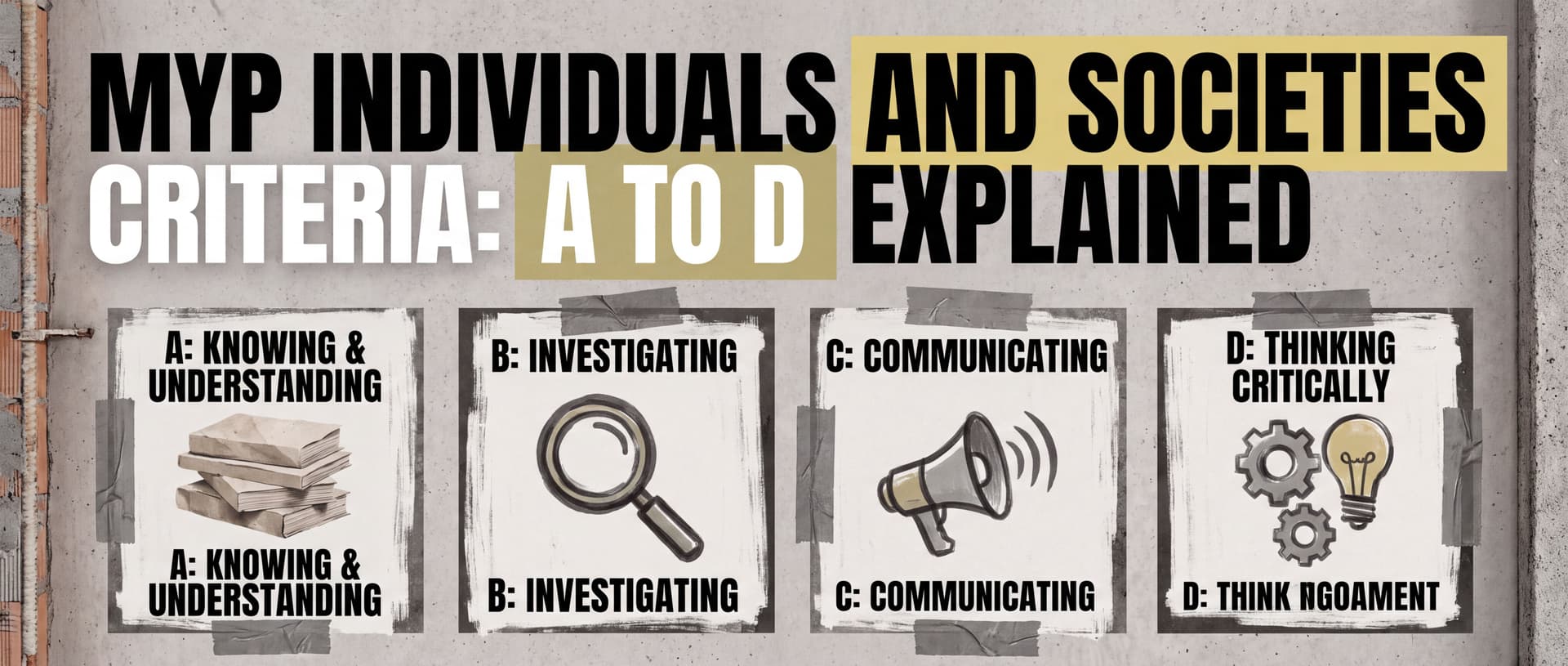
| A | Knowing and understanding | 8 |
| B | Investigating | 8 |
| C | Communicating | 8 |
| D | Thinking critically | 8 |
The IB subject brief confirms that these four criteria are equally weighted and that each has achievement levels up to 8.
Source: IB MYP Individuals and Societies subject brief
Those names matter. Individuals and Societies does not use the Sciences Criterion B, C and D labels. It does not use Mathematics Criterion B either. Criteria share letters across MYP subjects, but the skills attached to those letters change.
If you are studying History, Geography, Economics, Integrated Humanities or another MYP Individuals and Societies course, this is the rubric you need to understand.
Why the Four Criteria Measure Different Things
The IB describes Individuals and Societies as a subject group built around inquiry, research, interpretation and the study of human societies. Students work with data, original sources and complex information rather than learning content only for recall.
Source: IB MYP Individuals and Societies
This explains the structure of the criteria.
Criterion A asks whether you understand the subject.
Criterion B asks whether you can conduct an investigation.
Criterion C asks whether you can communicate what you know appropriately.
Criterion D asks whether you can analyse evidence, build arguments and consider perspectives.
A beautifully written investigation can therefore still be weak in Criterion B if the research question and method are poorly designed.
A response with excellent facts can still struggle in Criterion D if it never analyses the evidence.
The criteria separate these abilities so that your feedback can show exactly what needs to improve.
For the wider grading process, including how criterion achievement relates to MYP reporting, see MYP Grading: Criteria A to D and the 1 to 7 Scale.
Criterion A: Knowing and Understanding
Criterion A is the most familiar part of the subject.
It assesses your ability to use subject terminology and demonstrate knowledge and understanding through descriptions, explanations and examples.
At Year 1, the emphasis begins with using vocabulary in context and demonstrating understanding of subject content.
By Year 5, the expectation becomes more demanding. Students are expected to use a wide range of terminology and produce developed explanations supported by accurate examples. The progression is not simply about learning more words. It is about using subject language precisely while showing increasingly developed understanding.
Source: MYP Individuals and Societies Guide
Imagine a History question about the causes of a revolution.
A weaker response might name taxation, food shortages and political inequality.
A stronger Criterion A response would explain how those factors contributed to instability, use relevant historical terminology correctly and support the explanation with specific evidence.
In Geography, the same principle applies. Naming urbanisation is different from explaining the processes driving urban growth and using relevant concepts accurately.
Criterion A therefore rewards knowledge that you can actually use.
Criterion B: Investigating
Criterion B is about the research process.
Students develop a research question, plan an investigation, collect relevant information and reflect on or evaluate the investigation.
The level of independence increases as students move through the MYP.
At Year 1, students are expected to explain why they chose a research question, follow an action plan, collect and record relevant information, and reflect on the process and results.
By Year 3, the question should be clear and focused, its relevance should be explained, and students should formulate their own action plan and use appropriate methods to collect information.
By Year 5, students are expected to formulate a clear and focused research question and justify its relevance, use research methods to collect appropriate, varied and relevant information, and evaluate both the process and results.
Source: MYP Individuals and Societies Year 1 criteria
That progression matters.
Consider the question:
How did industrialisation affect Manchester?
It gives a topic, but the investigation may still be too broad.
A more focused question might examine a particular period and a specific consequence, such as population growth, housing conditions or employment.
Criterion B asks what happens after that question too.
Which sources will you need?
In what order will you investigate?
How will you record information?
Did your methods actually help you answer the question?
What limitations appeared?
Research is being assessed as a process, not simply as a finished report.
Criterion C: Communicating
Criterion C assesses how effectively you present information and ideas.
Students sometimes interpret this as a criterion for spelling and attractive formatting. That is much too narrow.
Communication includes clarity, organisation, suitability for the audience and purpose, the required format, and correct handling of sources.
At Year 1, students communicate ideas clearly, organise them effectively for the task and list sources according to the instructions.
By Year 3, students are expected to communicate in a way appropriate to the audience and purpose, structure ideas according to the task and create a reference list while citing information.
By Year 5, the expectations include effective communication using an appropriate style, organisation that suits the specified format and documentation of sources using a recognised convention.
Source: MYP Individuals and Societies Guide
The words audience, purpose and format deserve attention.
A museum information panel should not sound identical to an academic report.
A speech to a local council should not be structured like a historical essay.
A newspaper article has different communication requirements from an investigation report.
Strong Criterion C performance therefore begins before you start writing. Ask who the audience is, why you are communicating and what the required format allows you to do.
Criterion D: Thinking Critically
Criterion D is where many students discover that knowing the material is not enough.
It deals with ideas, arguments, sources and perspectives.
At Year 5, students are expected to discuss concepts and issues, synthesise information into valid arguments, analyse and evaluate sources, and interpret different perspectives and their implications.
Source: MYP Individuals and Societies Guide
The Year 1 expectation is already more demanding than simply stating a personal view.
The current Year 1 rubric explicitly requires students to “use information to justify an opinion.”
Source: MYP Individuals and Societies Year 1 criteria
That word justify matters.
Consider this statement:
The government made the wrong decision.
That is an opinion.
Now consider:
The policy was unlikely to solve the immediate housing shortage because construction remained below the rate of population growth shown in the available data.
That is moving towards justification because the opinion is supported with relevant information.
Criterion D also assesses source work.
By Year 1, students consider the origin and purpose of sources.
By Year 3, they begin recognising value and limitations.
By Year 5, students analyse and evaluate a wide range of sources in terms of origin and purpose while examining their value and limitations. The progression then extends to increasingly sophisticated treatment of perspectives.
Source: MYP Individuals and Societies assessment criteria
This is why copying information from several sources does not demonstrate strong critical thinking.
You need to do something with the evidence.
How the Rubric Changes From Year 1 to Year 5
The criterion names remain the same. The sophistication expected from students changes.
The table below summarises the progression. It is a practical condensation of the published objectives rather than a replacement for your school's complete task specific rubric.
| Criterion | Year 1 emphasis | Year 3 development | Year 5 expectation |
|---|---|---|---|
| A | Use vocabulary and demonstrate understanding | Use a range of terminology and developed explanations | Use a wide range of terminology and demonstrate detailed understanding |
| B | Explain a research question, follow a plan, collect information and reflect | Develop a focused question, plan the investigation, use research methods and evaluate with guidance | Justify a focused question, follow a substantial investigation process, collect varied relevant information and evaluate |
| C | Communicate clearly, organise ideas and list sources | Adapt communication to audience and purpose, structure the response and cite sources | Communicate effectively for audience, purpose and format, with recognised source documentation |
| D | Identify main points, justify opinions with information and examine source origin and purpose | Analyse ideas, construct supported arguments and recognise source value, limitations and perspectives | Discuss issues, synthesise evidence, evaluate sources and interpret perspectives and implications |
Source: MYP Individuals and Societies Guide
Notice what changes.
The progression is not simply more content.
Students gradually move from identifying towards analysing, from reflecting towards evaluating, from listing sources towards documenting them systematically, and from stating supported ideas towards synthesising arguments.
That progression is what teachers are looking for when they compare your work with the appropriate year level descriptors.
What the Achievement Bands Actually Mean
Each criterion reaches a maximum achievement level of 8.
The framework uses four achievement bands, with 0 available when the work does not reach the described standard. The bands move through 1 to 2, 3 to 4, 5 to 6 and 7 to 8.
Teachers make a best fit judgement based on the evidence in the work rather than calculating a percentage.
Source: MYP Individuals and Societies Guide
This means a 6 out of 8 is not 75 percent.
It means the work most closely matches the achievement descriptor associated with that level.
The difference between bands often appears in the quality of the thinking.
A student may move from identifying sources to analysing them.
A research question may move from simply existing to being focused and justified.
An argument may move from using some information to synthesising evidence into a well supported conclusion.
Instead of asking, “How many more points do I need?”, ask, “What does the next descriptor require me to do differently?”
That is much closer to how MYP assessment works.
Why One Task May Assess More Than One Criterion
The criteria describe different abilities, but real Individuals and Societies tasks often bring several together.
The official eAssessment structure demonstrates this overlap.
The investigating task assesses Criteria A and B. The communication task involves Criteria A and C. The thinking critically task draws on Criteria A, C and D.
Source: IB MYP Individuals and Societies subject brief
The same thing can happen in classroom assessments.
An investigation may require Criterion B research skills while also giving evidence for knowledge or communication.
A source based essay may require Criterion D analysis while still depending on Criterion A understanding.
This does not mean every assignment should automatically assess all four criteria.
It means the criterion tells you which evidence the teacher is judging within that task.
Always read the task specific clarification your teacher provides.
How to Improve Across All Four Criteria
A useful revision strategy is to stop treating Individuals and Societies as one single skill.
For Criterion A, practise explaining concepts without relying on memorised definitions.
For Criterion B, inspect whether your research question, plan and method genuinely work together.
For Criterion C, check the audience, purpose, format, organisation and source documentation before submitting.
For Criterion D, build a habit of asking what the evidence proves, what its limitations are, which perspectives differ and why your conclusion is justified.
One answer can contain excellent knowledge and weak critical thinking. Another can contain sophisticated analysis but communicate it poorly.
Your criterion profile helps you see that distinction.
For an example of how another MYP subject assigns very different meanings to the same A to D labels, read MYP Mathematics Criteria A to D: Complete Guide.
From MYP Individuals and Societies to the DP
These skills continue to matter after MYP.
The IB states that MYP Individuals and Societies develops research and investigation skills that provide preparation for later study in Diploma Programme subjects in the same subject group.
Source: IB DP Individuals and Societies
The DP subject group includes areas such as History, Geography, Economics, Business Management, Global Politics, Psychology and Philosophy.
The content changes, but the habits are recognisable: use evidence carefully, investigate questions, analyse arguments and communicate conclusions clearly.
If you are deciding which MYP subjects will support your next stage, read Choosing MYP 4 and 5 Subjects to Keep DP Options Open.
You can also explore the Koncepts MYP study hub for subject notes and practice designed around MYP learning.
The Simplest Way to Remember the Four Criteria
Criterion A asks: Do I understand it?
Criterion B asks: Can I investigate it?
Criterion C asks: Can I communicate it effectively?
Criterion D asks: Can I think critically about it?
The letters are easy to memorise.
The real improvement comes from understanding the evidence each criterion demands.
When you receive your next Individuals and Societies assessment, do not look only at the topic.
Look at the criterion.
Then ask what that criterion requires you to do with the topic.
That is where the rubric becomes useful.
Related Blogs
MYP Grading: Criteria A to D and the 1 to 7 Scale
Table of contents
Share
Related reading
- MYP Mathematics Criteria A–D: Complete GuideA practical guide to MYP Mathematics Criteria A, B, C and D, including what each assesses, common task-design problems, and practical ways to strengthen teaching and assessment.
- IB MYP Feedback Writer: Strand-Level Feedback That Reads the Student's Actual WorkKoncepts Feedback Writer reads student PDFs, quotes their work to justify strand scores and writes report comments for a whole class in one batch.
- IB MYP Assessment Generator: Build Criterion-Tagged Questions with the Right Command TermsKoncepts Assessment Generator enforces MYP command terms by level band, loads criterion strand descriptors and exports separate student and teacher PDFs.
- The Three Koncepts Tools Every IB MYP Teacher Should Know: Assessment Generator, Unit Planner & Feedback WriterChatGPT doesn't know MYP criteria. These three Koncepts tools do. Assessment Generator, Unit Planner, and Feedback Writer built for IB teachers.
- How to Create MYP Assessments Faster (GRASP Tasks, Tests, Criterion-Aligned)A practical workflow to create MYP assessments faster authentic task design rules, a full GRASPS worked example, and criterion alignment. Target keywords used: create MYP assessment, GRASPS model MYP, MYP assessment task design, MYP assessment generator
