The Hidden Tension Every IB Student Feels
For most students in the International Baccalaureate (IB) Diploma Programme, there is a quiet but constant question:
Do predicted grades matter more, or do final results decide everything?
It is a question that shapes stress, strategy, and expectations throughout the two-year journey. Schools emphasize predicted grades. Universities ask for final results. Students sit somewhere in between, trying to decode what truly determines their future.
The reality in 2026 is more nuanced than ever.
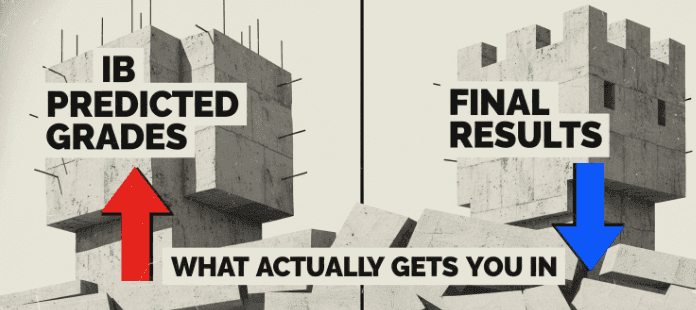
Predicted grades can open doors. Final results decide whether you get to walk through them.
This blog breaks down the real relationship between predicted and final IB scores, how universities interpret both, and what students must do to stay in control of their outcomes.
1. What Are IB Predicted Grades?
Predicted grades are a school’s estimate of the score a student is likely to achieve in their final IB exams.
These predictions are typically based on:
- Internal assessments (IAs)
- Class tests and mock exams
- Teacher evaluation of consistency and effort
- Historical school performance patterns
They are submitted to universities as part of your application, especially for early admissions cycles.
Why predicted grades matter
Predicted grades are your first impression.
Universities use them to:
- Assess your academic capability before final exams
- Compare you with other applicants globally
- Make conditional offers
In many cases, especially for competitive universities, predicted grades determine whether your application is even considered seriously.
2. What Are Final IB Results?
Final results are the official scores awarded by the :contentReference[oaicite:0]{index=0} after exams and moderation.
They include:
- External exam performance
- Moderated internal assessments
- Core components (TOK, EE, CAS)
These results are standardized globally and carry the final authority.
Why final results matter
Final results are your verification layer.
They decide:
- Whether you meet university offer conditions
- Whether your admission is confirmed, rejected, or reconsidered
- Scholarship eligibility in many cases
In simple terms: Predicted grades get you an offer. Final results decide if you keep it.
3. How Universities Actually Use Predicted Grades
Understanding how universities interpret predicted grades is key to building the right strategy.
a) Conditional offers
Most universities, especially in the UK and Europe, give conditional offers.
Example:
- Offer: 38 points with 6,6,6 in HL subjects
- Your predicted: 39
You receive the offer based on your predicted score.
But this is not acceptance—it is a contract.
You must meet those conditions in your final results.
b) Holistic evaluation (US and Canada)
In countries like the United States and Canada, predicted grades are important but not the only factor.
Universities consider:
- Essays
- Extracurricular activities
- Recommendation letters
- Overall academic trajectory
Here, predicted grades act as academic validation, but not the sole decision-maker.
c) The risk of inflated predictions
Some schools tend to over-predict.
Universities are aware of this.
They often:
- Track school prediction accuracy over time
- Adjust expectations based on historical data
- Treat unusually high predictions with caution
This means not all predicted grades carry equal weight.
4. The Reality Check: Predicted vs Final Gap
One of the most stressful realities for IB students is the gap between predicted and final scores.
Why this gap happens
a) Internal vs external evaluation
Predicted grades are internal. Final results are external and moderated globally.
This creates differences in:
- Marking strictness
- Evaluation criteria
- Examiner expectations
b) Exam pressure
Many students perform differently under real exam conditions compared to school assessments.
Common issues:
- Time management breakdown
- Anxiety and performance dips
- Unexpected question patterns
c) Moderation adjustments
Internal assessments are moderated to align with global standards.
This can lead to:
- Score reductions if internal grading is lenient
- Rare increases if internal grading is strict
The consequence
A difference of even 2–3 points can:
- Miss university conditions
- Lead to offer withdrawal
- Force last-minute backup planning
5. What Actually Gets You In?
This is the core question.
The answer is not predicted or final grades alone—it is the combination and timing of both.
Stage 1: Predicted grades get you shortlisted
Without strong predicted grades:
- You may not receive competitive offers
- Your application may be filtered out early
Predicted grades determine access.
Stage 2: Final results confirm your place
Even with an offer:
- Falling below conditions can cost your seat
- Universities may not always be flexible
Final results determine outcome.
The real formula
Predicted Grades = Opportunity
Final Results = Conversion
Both matter. But they matter at different stages.
6. The Psychological Trap Students Fall Into
Many students make one of two mistakes:
Mistake 1: Overvaluing predicted grades
They believe:
- “I already have the offer, I’m safe.”
This leads to:
- Reduced effort after applications
- Complacency during revision
Mistake 2: Ignoring predicted grades
They think:
- “Final exams matter more, I’ll focus later.”
This leads to:
- Weak applications
- Missed opportunities at top universities
The balanced mindset
Top students treat predicted and final grades as a continuous performance cycle, not separate events.
7. What Top Students Do Differently
Students who successfully convert offers into admissions follow distinct strategies.
a) They treat predicted grades as a launchpad
They:
- Maximize internal assessments
- Perform strongly in mocks
- Build teacher confidence
This ensures strong predictions.
b) They don’t relax after offers
Instead of slowing down, they:
- Increase exam-focused preparation
- Practice past papers consistently
- Target weak subjects early
c) They understand mark schemes deeply
They focus on:
- How answers are evaluated
- What earns full marks
- Where marks are commonly lost
d) They prepare for exam conditions, not just content
They simulate:
- Timed exams
- Full-length papers
- Real pressure scenarios
8. Strategic Advice for IB Students in 2026
To navigate predicted vs final grades effectively, students must adapt strategically.
Step 1: Build strong internal performance early
Focus on:
- IA quality
- Class tests
- Mock exams
These shape your predicted grades.
Step 2: Track your realistic score range
Know:
- Your consistent performance level
- Your weak subjects
- Your margin for improvement
Avoid relying on optimistic predictions alone.
Step 3: Start exam preparation earlier than usual
Do not wait for:
- Final months
- School revision schedules
Begin structured past paper practice early.
Step 4: Have a backup plan
Even top students face uncertainty.
Prepare:
- Backup universities
- Clearing options (if applicable)
- Flexible expectations
9. The Future Trend: Narrower Margins
In 2026, the difference between meeting and missing an offer is often minimal.
- One subject dropping from 6 to 5
- A 2–3 mark boundary shift
- Slight IA moderation changes
These small variations have large consequences.
This is why precision matters more than ever.
Conclusion: The Truth About IB Admissions
IB admissions are not decided in a single moment.
They are a two-stage process:
- Predicted grades open the door
- Final results decide if you stay inside
Ignoring either stage is risky.
Success in the IB today is not just about working hard. It is about understanding how the system evaluates you at every step.
Students who succeed are not just academically strong. They are strategically aware.
They know when to push, when to stabilize, and how to align their performance with what universities actually expect.
In the end, getting in is not about predicted vs final.
It is about mastering both.