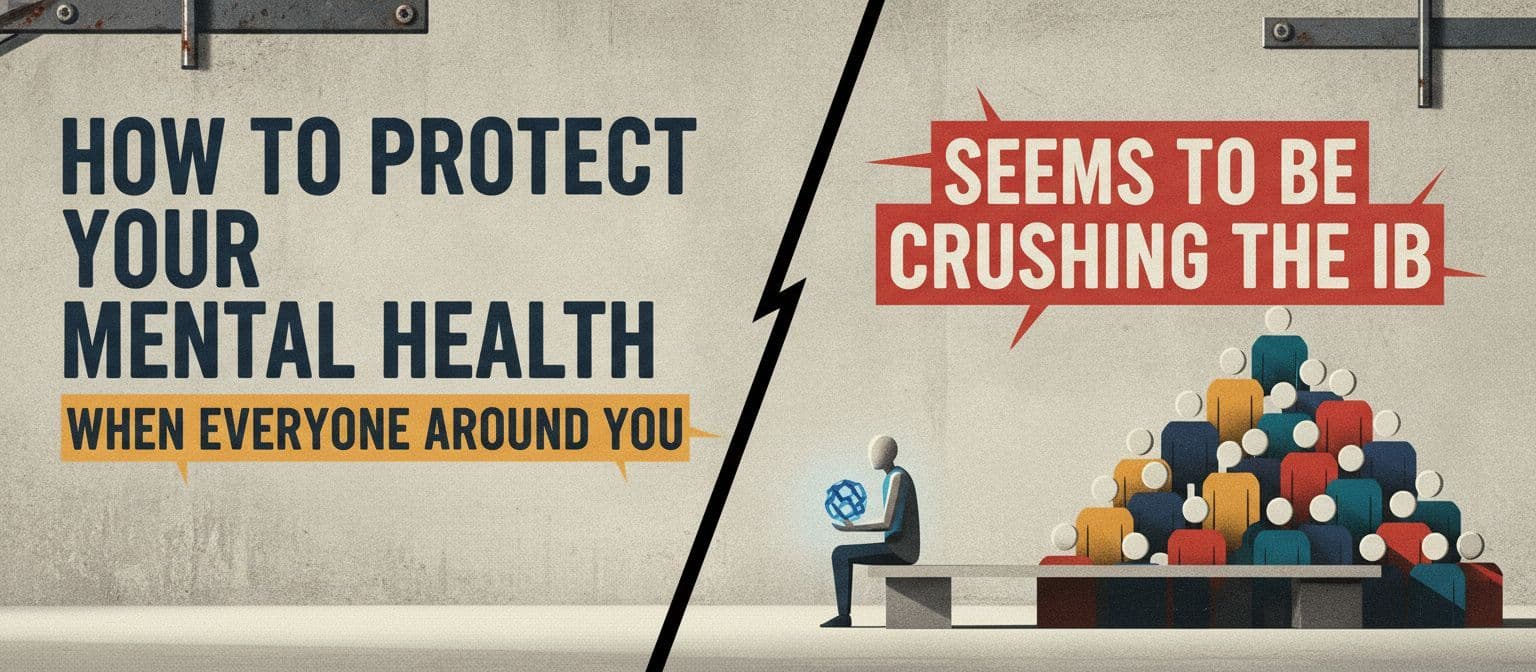
The Silent Pressure Every IB Student Knows
There is a particular kind of stress that comes with the International Baccalaureate. It is not just the workload, the deadlines, or the exams. It is the constant feeling that everyone around you is somehow doing better than you.
You walk into class and hear someone discussing their Extended Essay draft that is already complete. Another student talks about scoring a 7 in Higher Level Mathematics. Someone else casually mentions finishing their Internal Assessment weeks ahead of schedule. Meanwhile, you are staring at your to do list wondering how it became longer overnight.
The most difficult part is that nobody teaches you how to deal with this feeling.
The IB is designed to challenge students academically, but the psychological challenge often goes unnoticed. The pressure to perform, compare, and constantly improve can slowly affect your mental health if left unchecked.
If you feel like everyone around you is crushing the IB while you struggle to keep up, you are not alone. More importantly, there are practical ways to protect your mental well being without sacrificing your academic goals.
The IB Creates a Perfect Environment for Comparison
Comparison is a natural human behavior. Unfortunately, the IB environment amplifies it.
Unlike many academic programs, the IB places students in situations where achievements become highly visible. Internal assessments, predicted grades, extracurricular activities, university applications, Extended Essays, and CAS projects all become topics of daily conversation.
As a result, students often begin measuring their self worth against the achievements of others.
The problem with comparison is that you rarely compare the full picture.
You compare your struggles with someone else's highlights.
You compare your unfinished draft with their polished final submission.
You compare your anxiety with their confidence.
What you do not see are their sleepless nights, their self doubt, their private setbacks, or the support systems they may have.
Comparison creates an illusion that everyone else is succeeding effortlessly while you are falling behind.
That illusion can become dangerous if you start believing it.
Being Surrounded by High Achievers Can Distort Reality
One of the unique challenges of the IB is that you are often surrounded by exceptionally motivated students.
This sounds like an advantage, and in many ways it is. Being around ambitious peers can inspire growth and healthy competition.
However, it can also distort your perception of what is normal.
If every student around you appears to study six hours daily, participate in extracurricular activities, maintain perfect grades, and still have a social life, you may start believing that anything less represents failure.
This mindset creates impossible expectations.
The reality is that every student has different strengths, circumstances, learning styles, and coping mechanisms. What works for one person may be completely unsustainable for another.
Success in the IB is not about copying someone else's routine. It is about building a system that allows you to perform consistently without destroying your mental health.
Recognize the Difference Between Pressure and Motivation
Many students confuse pressure with motivation.
Pressure feels like fear.
It tells you that if you fail one assignment, your future will collapse.
It convinces you that every test determines your worth.
It creates panic, exhaustion, and guilt.
Motivation, on the other hand, comes from purpose.
It encourages progress rather than perfection.
It allows mistakes without turning them into personal failures.
When you constantly feel overwhelmed, ask yourself an important question:
"Am I working because I am motivated, or because I am terrified of falling behind?"
The answer can reveal whether your current approach is helping or harming you.
Stop Using Other People's Timelines as Your Benchmark
One of the fastest ways to damage your mental health in the IB is to adopt someone else's timeline as your standard.
Perhaps your friend completed their Extended Essay in June.
Maybe another student finished their Internal Assessment weeks early.
Someone else might already have their university application essays prepared.
These achievements can make you feel inadequate.
But academic progress is not a race with a universal finish line.
Some students work best under structured schedules. Others perform better with flexible planning. Some learn quickly through reading, while others need repetition and practice.
The fact that another student is ahead of you in one area does not mean you are failing.
Your goal should not be to keep pace with everyone else.
Your goal should be to maintain steady progress without compromising your mental health.
Create Boundaries Around Academic Conversations
This advice may sound surprising, but sometimes the healthiest thing you can do is stop talking about school.
Many IB students unintentionally turn every interaction into an academic discussion.
Conversations become dominated by:
- Predicted grades.
- University applications.
- Assignment deadlines.
- Study schedules.
- Test scores.
Over time, your brain never receives permission to rest.
You begin living in a permanent state of academic alertness.
Creating boundaries does not mean avoiding responsibility. It means protecting your mental space.
Consider setting personal rules such as:
- Avoid discussing grades after a certain time each day.
- Take breaks from academic group chats.
- Spend time with people without talking about school.
- Schedule activities unrelated to academics.
Your brain needs recovery periods to function effectively.
Protect Your Sleep Like It Is Part of Your Curriculum
Many students treat sleep as optional during the IB.
This is one of the biggest mistakes you can make.
Sleep affects:
- Memory formation.
- Problem solving.
- Emotional regulation.
- Concentration.
- Stress management.
Ironically, sacrificing sleep often reduces productivity rather than increasing it.
Students who consistently sleep well frequently outperform students who study longer but remain chronically exhausted.
A tired brain does not learn efficiently.
Protecting your sleep is not laziness.
It is an academic strategy.
If you had to choose between an additional hour of exhausted studying and an additional hour of quality sleep, the long term benefits of sleep would often be greater.
Learn to Separate Your Identity from Your Grades
The IB can slowly convince students that academic performance defines personal value.
A low score begins to feel like evidence that you are not intelligent enough.
A missed deadline feels like a character flaw.
A disappointing predicted grade feels like a judgment of your entire future.
None of these beliefs are true.
Grades measure performance under specific conditions.
They do not measure:
- Intelligence.
- Character.
- Potential.
- Creativity.
- Resilience.
- Worth.
When your identity becomes attached to your academic results, every setback becomes emotionally devastating.
Protecting your mental health requires maintaining a separation between who you are and what score appears on your report card.
You are a person who takes exams.
You are not your exam results.
Build a Support System Before You Need One
Many students wait until they reach a crisis point before asking for help.
By then, stress has often accumulated for months.
Instead, build support systems proactively.
This support can come from:
- Friends.
- Parents.
- Teachers.
- School counselors.
- Mentors.
- Study partners.
Having people who understand your struggles creates emotional resilience.
Sometimes, you do not need solutions.
You simply need someone who listens without judgment.
Seeking support is not a sign of weakness.
It is a recognition that no one is meant to navigate intense academic pressure entirely alone.
Focus on Progress Instead of Perfection
Perfectionism is one of the most common psychological challenges among IB students.
The desire to achieve perfect grades can become so overwhelming that students begin avoiding tasks altogether because they fear doing them imperfectly.
This creates a cycle of:
- Anxiety.
- Procrastination.
- Guilt.
- Increased anxiety.
Breaking this cycle requires changing your definition of success.
Instead of asking:
"Did I do this perfectly?"
Ask:
"Did I make progress today?"
Progress creates momentum.
Perfection creates paralysis.
A completed assignment that is good is almost always more valuable than a perfect assignment that never gets finished.
Remember That Everyone Is Fighting Invisible Battles
The student who appears calm may be dealing with anxiety.
The student earning top grades may be sacrificing sleep and personal relationships.
The student who seems confident may secretly feel overwhelmed.
Academic environments often reward appearances.
People learn to hide their struggles.
This creates the illusion that everyone else is coping perfectly.
They are not.
Many of your classmates likely share the same fears, insecurities, and pressures that you experience.
Recognizing this does not eliminate your struggles, but it can reduce the loneliness that often accompanies them.
Final Thoughts
The International Baccalaureate is designed to challenge you intellectually. Unfortunately, it can also challenge your emotional well being if you allow comparison and pressure to define your experience.
There will always be someone who studies more, scores higher, finishes earlier, or appears more confident.
Chasing everyone else's success is a race with no finish line.
Protecting your mental health does not mean lowering your ambitions. It means recognizing that long term success requires both academic achievement and emotional stability.
The goal is not to prove that you can survive the IB at any cost.
The goal is to complete it while still recognizing yourself when it is over.
Table of contents
Share
Related reading
- IB Results Day Is Here: Stay Calm Through Every EmotionNavigate every emotion on IB Results Day with confidence. Learn practical ways to manage stress, disappointment, and success while planning your next steps.
- Why Comparing Yourself in the IB Can Destroy Your Mental HealthStruggling with comparison in the IB? Learn practical strategies to protect your mental health, avoid burnout, and thrive academically.
- IB Results Day 2026: What Every Student Needs to Hear FirstIB Results Day 2026 can be overwhelming. Learn how to support students with empathy, practical guidance, and confidence after disappointing results.
- How to Balance Social Life and IB Without BurnoutStruggling to balance IB and friendships? Learn practical ways to maintain a social life, avoid burnout, and succeed in the IB program.
- IB Teacher Burnout Starts Early: Protect Your Energy in Term 1Discover practical, research backed strategies that help IB teachers prevent burnout in Term 1 while maintaining teaching excellence and work life balance.
