Introduction
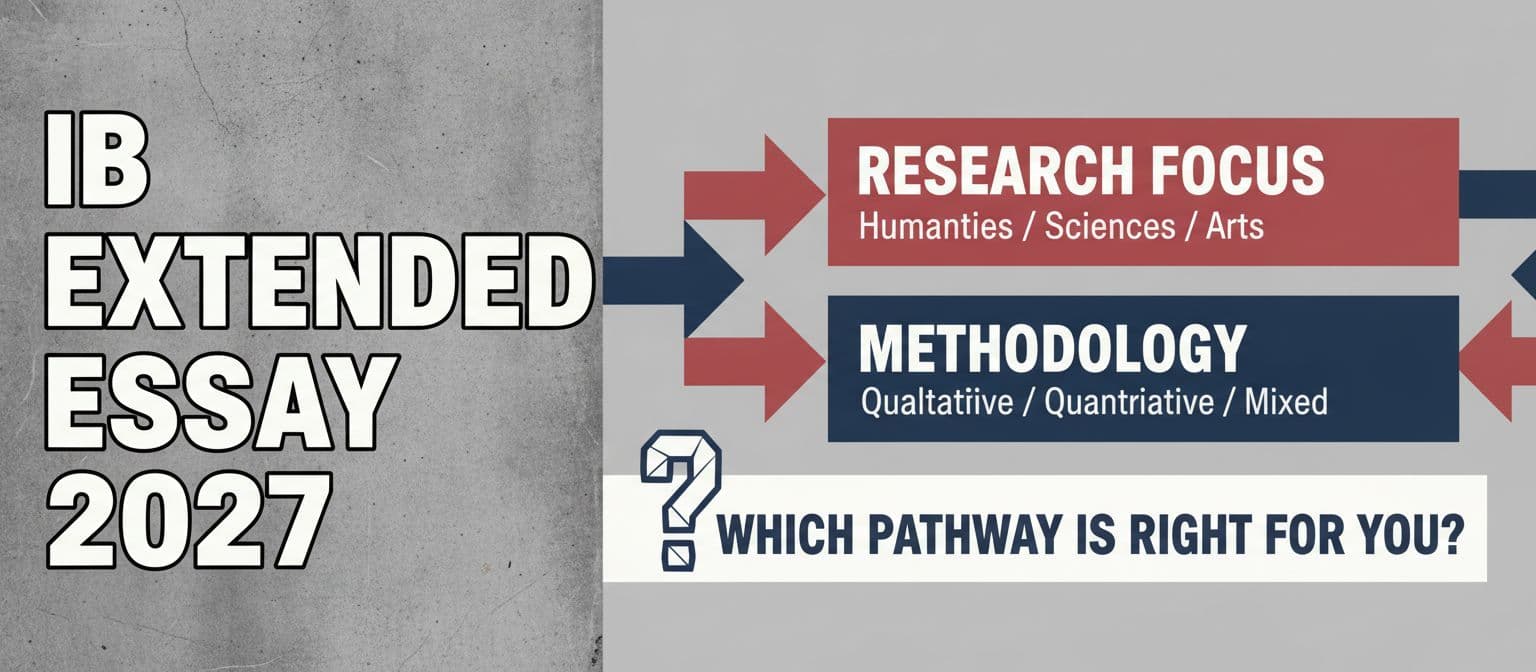
Choosing an Extended Essay topic has always been one of the biggest milestones in the International Baccalaureate Diploma Programme. It challenges students to think independently, conduct meaningful research, and communicate ideas through academic writing. With the introduction of the new Extended Essay framework for 2027, students now face an even more important decision before they begin writing.
Instead of following a single structure, students will now choose between two distinct pathways. While both lead to the same goal of producing a high quality research project, they are designed for different learning styles, research interests, and academic strengths.
For many students, the biggest challenge is not writing the essay itself. It is choosing the pathway that best matches their abilities and long term goals.
This guide explains everything students, parents, and educators need to know about the new IB Extended Essay pathways and offers practical advice for making the right choice.
What Has Changed in the IB Extended Essay for 2027?
The International Baccalaureate has updated the Extended Essay to provide greater flexibility while maintaining its focus on academic inquiry and critical thinking.
The new framework recognizes that students approach research in different ways. Some enjoy building arguments from books, journals, and existing research, while others learn best through investigation, experimentation, design, or real world engagement.
By introducing two pathways, the IB aims to support a wider range of learners while preserving the academic rigor that defines the Diploma Programme.
The emphasis is no longer simply on producing a research paper. Instead, students are encouraged to demonstrate curiosity, analytical thinking, reflection, and the ability to manage an independent research project.
Understanding the Two Pathways
Although both pathways require students to formulate a clear research question, conduct research, and produce an academic essay, their approaches differ.
The first pathway follows a traditional academic research model. Students investigate a focused question using scholarly sources, evaluate evidence, and build a well supported argument. This pathway is familiar to students interested in subjects such as History, English, Economics, Psychology, Philosophy, and many humanities disciplines.
The second pathway places greater emphasis on investigation, exploration, and practical application. Depending on the subject, students may analyze original data, conduct experiments, develop creative work, design solutions, or examine real world case studies. This approach encourages students to engage directly with their research rather than relying only on secondary literature.
Neither pathway is easier than the other. Both demand careful planning, critical thinking, and academic integrity.
Why Did the IB Introduce Two Pathways?
Education has changed significantly over the past decade.
Universities increasingly value students who can solve problems, analyze information from multiple perspectives, and apply knowledge beyond textbooks.
The IB recognized that one research model could not effectively represent the diversity of subjects offered within the Diploma Programme.
Science students often approach research differently from literature students.
Design students investigate problems differently from historians.
Business students frequently work with data and case studies rather than purely theoretical analysis.
The updated framework reflects these differences while maintaining consistent academic standards.
Ultimately, the goal is to allow students to demonstrate their strengths through a pathway that aligns with their subject and preferred research style.
Key Differences Between the Two Pathways
The traditional research pathway focuses primarily on reviewing existing knowledge. Students gather evidence from reliable academic sources, compare viewpoints, evaluate arguments, and answer a focused research question through logical analysis.
The investigative pathway encourages students to engage more directly with their topic. This may involve collecting original information, conducting experiments, producing creative outputs, analyzing primary data, or investigating practical problems.
Students following the traditional pathway often spend more time reading academic literature.
Students choosing the investigative pathway usually spend more time planning research methods, collecting information, and interpreting findings.
Both pathways require strong academic writing skills, proper citations, structured arguments, and thoughtful reflection.
Which Students Should Choose the Traditional Research Pathway?
This pathway may be the better choice for students who enjoy reading, writing, and evaluating different perspectives.
It is particularly suitable for students who enjoy subjects where arguments are built through evidence from books, journals, historical documents, literary texts, or policy analysis.
Students considering university courses in law, political science, literature, history, economics, sociology, or international relations may also find this pathway closely aligned with future academic expectations.
If you enjoy asking "Why?" and building detailed arguments supported by scholarly evidence, this pathway is likely to suit your strengths.
Which Students Should Choose the Investigative Pathway?
Students who enjoy experimentation, observation, data collection, or creative problem solving may find this pathway more engaging.
It is especially relevant for students interested in sciences, technology, environmental studies, business innovation, design, engineering, or interdisciplinary research.
If you prefer learning by doing rather than only reading, this pathway allows you to demonstrate research skills through practical investigation while maintaining academic standards.
Students who enjoy surveys, laboratory work, field observations, interviews, statistical analysis, or product design may naturally perform well within this approach.
Factors to Consider Before Choosing
Selecting the right pathway should never be based on what friends choose.
Instead, students should evaluate several important factors.
Consider your strongest subjects.
Think about how you naturally approach learning.
Assess the resources available at your school.
Discuss your ideas with your Extended Essay supervisor.
Reflect on the amount of time required for different research methods.
Some projects require extensive data collection or experiments, while others demand intensive reading and literature review.
Choosing a pathway that genuinely matches your interests often leads to better motivation throughout the research process.
Common Mistakes Students Should Avoid
One common mistake is selecting a pathway simply because it appears easier.
Every successful Extended Essay requires months of planning, research, drafting, revision, and reflection.
Another mistake is choosing a topic that is too broad.
A focused research question almost always produces a stronger essay than an ambitious question covering multiple themes.
Students should also avoid selecting topics with limited research material or projects that cannot realistically be completed within the available time.
Ignoring feedback from supervisors is another frequent problem.
Regular discussions with supervisors help students refine their research question, improve methodology, and avoid unnecessary challenges later in the writing process.
Tips for Teachers and Parents
Teachers play a vital role in helping students understand the strengths and expectations of each pathway.
Rather than recommending one option for every student, educators should encourage thoughtful self assessment and realistic planning.
Parents can support students by creating a structured study environment and encouraging consistent progress throughout the research journey.
The Extended Essay should never become a last minute project.
Small, consistent milestones are far more effective than attempting to complete the essay within a few weeks.
Looking Ahead
The new Extended Essay framework reflects the IB's broader commitment to preparing students for higher education and future careers.
Research today is no longer limited to libraries. It involves critical thinking, collaboration, creativity, data analysis, ethical decision making, and effective communication.
By offering two pathways, the IB acknowledges that successful researchers can approach problems in different ways while maintaining the same commitment to academic excellence.
Students who carefully evaluate their strengths, choose an appropriate pathway, and remain consistent throughout the research process will be well positioned to produce an essay that showcases both their knowledge and their ability to think independently.
Final Thoughts
The introduction of two Extended Essay pathways is not about making the programme easier. It is about making it more meaningful.
The best pathway is not the one that sounds impressive or appears less demanding. It is the one that allows you to demonstrate genuine curiosity, conduct high quality research, and communicate your ideas with confidence.
If you begin with the right choice, stay organized, and seek regular guidance from your supervisor, the Extended Essay can become one of the most rewarding academic experiences of the IB Diploma Programme.
Instead of viewing the new framework as another decision to worry about, treat it as an opportunity to choose the research journey that best reflects your strengths, interests, and future ambitions.
Table of contents
Share
Related reading
- IB's Biggest Extended Essay Change in Years: Which Pathway Wins?IB's Extended Essay changes in 2027. Discover the two new pathways, compare their benefits, and choose the right EE strategy now.
- IB Extended Essay Is Changing in 2027: Choose the Right PathDiscover the new IB Extended Essay pathways from 2027. Compare Subject Focused and Interdisciplinary options to choose the best fit for your goals.
- Pick Your IB Extended Essay Topic Early and Stay AheadPick your IB Extended Essay topic before DP2 begins and avoid last minute stress. Learn how early planning leads to stronger research and higher scores.
- Extended Essay Topics That Consistently Score 34+Struggling to choose your EE topic? Discover high-scoring Extended Essay ideas and proven strategies to hit 34+. Start smart and maximize your IB score.
- Pick the Perfect EE Topic for the New 2027 IB PathwayLearn how to choose the perfect IB Extended Essay topic for the new 2027 interdisciplinary pathway with expert tips, examples, and proven strategies.
