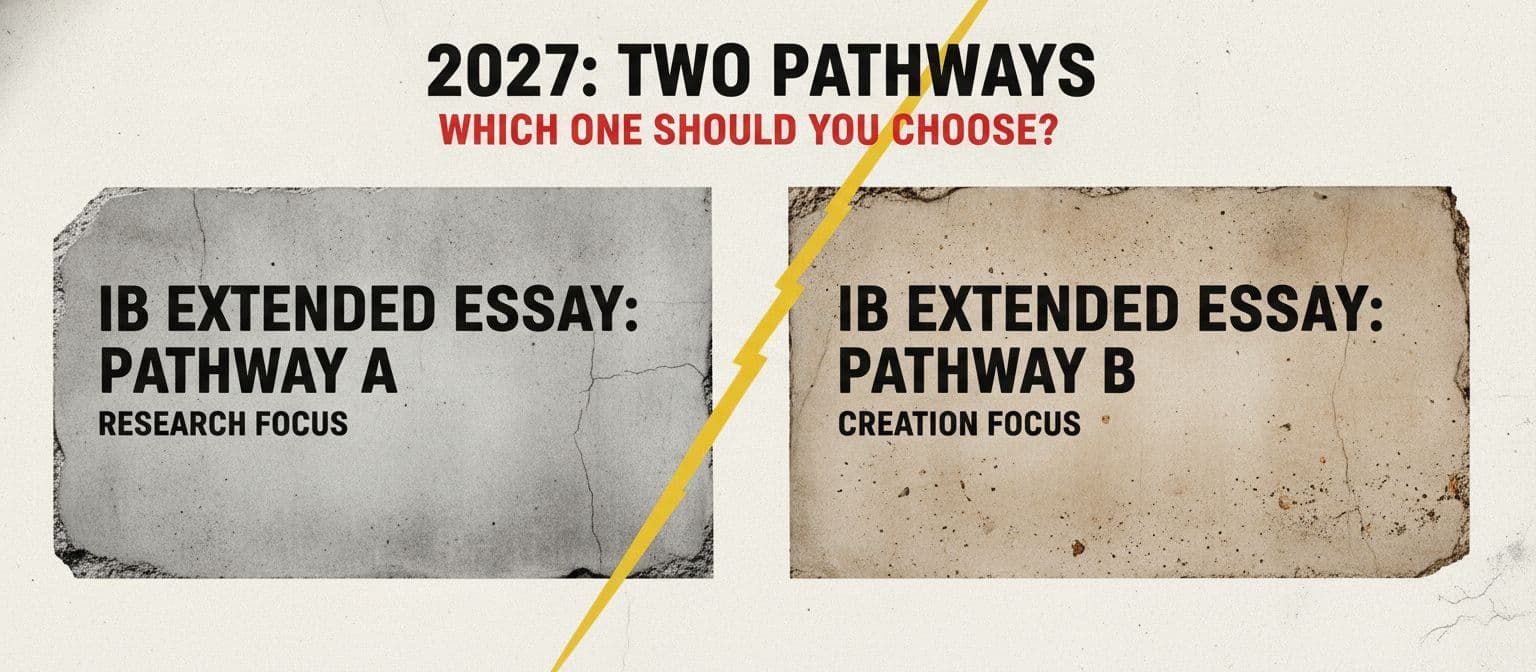
A Major Change Is Coming to the IB Extended Essay
For decades, the International Baccalaureate Extended Essay has followed a familiar structure. Students selected a subject, developed a research question, conducted independent research, and produced a 4,000 word academic essay grounded within that discipline.
Beginning with first assessment in May 2027, however, the IB has introduced one of the most significant changes to the Extended Essay in recent memory.
Students will now have two distinct pathways available when designing their Extended Essay:
- The Subject Specific Pathway
- The Interdisciplinary Pathway
At first glance, this appears to be a simple addition of flexibility. In reality, it fundamentally changes how students can approach independent research within the Diploma Programme.
The immediate question facing students is obvious:
Which pathway should you choose?
The answer is not as straightforward as many students expect. Choosing the wrong pathway can make the Extended Essay significantly more difficult. Choosing the right one can transform the experience from a stressful obligation into one of the strongest academic projects of your high school career.
What Exactly Is Changing in the New Extended Essay?
The new Extended Essay framework, first assessed in May 2027, preserves the core purpose of the EE: independent academic inquiry through a 4,000 word research paper. However, the structure through which students can pursue that inquiry has become more flexible.
Instead of requiring every essay to fit neatly into a single subject framework, the IB now officially recognizes two pathways:
Subject Specific Pathway
This pathway follows the traditional model that most IB students and teachers already understand.
Students select one Diploma Programme subject and conduct their research entirely through that discipline's concepts, methodologies, and academic conventions.
Examples include:
- A History essay examining the causes of the Korean War.
- A Biology essay investigating enzyme activity.
- An Economics essay evaluating inflation targeting policies.
- An English Literature essay analyzing narrative techniques in a novel.
The key principle is simple: one subject, one disciplinary lens.
Interdisciplinary Pathway
The second pathway allows students to integrate two Diploma Programme subjects to investigate a research question that cannot be adequately answered through only one discipline.
Examples might include:
- Economics and Physics.
- Biology and Psychology.
- History and Global Politics.
- Computer Science and Mathematics.
Rather than forcing students to separate interconnected ideas, the new pathway acknowledges that many real world problems require multiple academic perspectives.
This represents a substantial philosophical shift in how the IB approaches independent research.
Why Did the IB Introduce Two Pathways?
The answer lies in the changing nature of knowledge itself.
Universities increasingly emphasize interdisciplinary thinking. Climate change, artificial intelligence, public health, economic inequality, and geopolitical conflicts cannot be understood through a single academic lens.
The IB appears to be responding to this reality by encouraging students to think beyond traditional subject boundaries.
At the same time, the IB recognizes that many students still benefit from the structure and clarity provided by a single discipline.
Rather than replacing the traditional Extended Essay, the new framework expands student choice.
In theory, this sounds ideal.
In practice, it creates a new challenge: deciding which option is actually right for you.
The Subject Specific Pathway: Who Should Choose It?
For most students, the Subject Specific Pathway will remain the safest and strongest option.
Why?
Because academic depth is often easier to achieve than academic breadth.
A successful Extended Essay requires:
- A clear research question.
- Appropriate methodology.
- Strong analysis.
- Critical evaluation.
- Consistent argumentation.
Managing all these elements within one subject is already difficult.
Introducing a second discipline increases complexity significantly.
The Subject Specific Pathway is particularly suitable if:
You Have a Clear Favorite Subject
If you genuinely enjoy History, Economics, Chemistry, Literature, or another subject, staying within that discipline often produces stronger work.
Passion matters.
Students tend to write better essays when they are genuinely curious about their topic.
You Prefer Clear Rules
Every IB subject has established conventions.
You know:
- Which methodologies are acceptable.
- Which sources are appropriate.
- How evidence should be analyzed.
- What examiners expect.
This clarity reduces uncertainty.
You Want to Minimize Risk
The traditional pathway has decades of examiner experience behind it.
Teachers understand it.
Schools understand it.
Universities understand it.
For many students, predictability is an advantage.
The Interdisciplinary Pathway: Who Should Choose It?
The Interdisciplinary Pathway offers exciting possibilities, but it is not automatically the better option.
In fact, for some students, it may become significantly more challenging.
However, it can be incredibly rewarding when chosen correctly.
You Have a Research Question That Cannot Be Answered Through One Subject
This is perhaps the most important criterion.
Suppose you want to investigate:
"How effective are AI driven medical diagnostic systems in improving healthcare outcomes?"
This question naturally combines:
- Computer Science.
- Biology.
- Ethics.
- Social considerations.
Attempting to force such a topic into a single subject may weaken the analysis.
You Enjoy Connecting Different Fields
Some students naturally think across disciplines.
They enjoy asking questions like:
- How does economics influence politics?
- How does psychology affect consumer behavior?
- How does mathematics improve computer science?
For these students, the interdisciplinary approach can feel more authentic.
You Are Comfortable With Complexity
Interdisciplinary research is demanding.
You must understand:
- Multiple methodologies.
- Different forms of evidence.
- Distinct academic frameworks.
- How to integrate disciplines effectively.
This requires intellectual flexibility and strong organizational skills.
The Biggest Misconception About the Interdisciplinary Pathway
Many students are likely to make one major mistake.
They will assume that combining two subjects automatically makes their essay more impressive.
It does not.
In fact, poorly designed interdisciplinary essays often become weaker than strong subject specific essays.
The challenge is not simply using two subjects.
The challenge is integrating them meaningfully.
For example:
A student writing fifty percent Economics and fifty percent Physics without any genuine connection between the two disciplines is unlikely to produce a successful interdisciplinary essay.
The strongest interdisciplinary essays typically have:
- One central research problem.
- Two disciplines that genuinely complement each other.
- A clear explanation of why both perspectives are necessary.
Interdisciplinary does not mean doing more.
It means thinking differently.
Which Pathway Is Better for University Applications?
Many students immediately wonder whether universities will prefer one pathway over another.
The answer is generally no.
Universities care far more about:
- Academic rigor.
- Research quality.
- Critical thinking.
- Intellectual curiosity.
A mediocre interdisciplinary essay will never outperform an excellent subject specific essay.
Admissions officers are interested in evidence of academic maturity, not simply complexity for its own sake.
That said, students pursuing highly interdisciplinary university programs may find that the new pathway better reflects their academic interests.
Examples include:
- Cognitive Science.
- Artificial Intelligence.
- Environmental Studies.
- International Relations.
- Public Policy.
In these cases, an interdisciplinary Extended Essay could strengthen the broader narrative of a student's application.
Questions Every Student Should Ask Before Choosing
Before selecting a pathway, ask yourself five important questions.
Can this research question realistically be answered using one subject?
If yes, the Subject Specific Pathway may be the better option.
Does adding another discipline genuinely improve the investigation?
If not, avoid unnecessary complexity.
Do I understand both disciplines well enough?
Weak knowledge in either subject can damage the entire essay.
Will my supervisor be able to support this project effectively?
Supervisor expertise matters more than many students realize.
Am I choosing this pathway because it is appropriate, or because it sounds impressive?
This final question may be the most important.
The Future of the Extended Essay
The introduction of two pathways reflects a broader trend in education.
The world increasingly values individuals who can:
- Analyze deeply.
- Think critically.
- Connect ideas across disciplines.
- Solve complex problems.
The new Extended Essay framework attempts to develop precisely these skills.
For some students, that journey will happen within a single academic discipline.
For others, it will happen at the intersection of multiple fields.
Neither approach is inherently superior.
Success depends entirely on choosing the pathway that aligns with your intellectual strengths, interests, and research goals.
Final Thoughts
The introduction of two Extended Essay pathways from 2027 is not simply an administrative update.
It represents a fundamental shift in how the IB understands research, learning, and academic inquiry.
The Subject Specific Pathway offers structure, clarity, and depth.
The Interdisciplinary Pathway offers flexibility, creativity, and broader intellectual exploration.
The temptation for many students will be to assume that the newer, more complex option is automatically better.
It is not.
The best Extended Essay has never been the most complicated one.
It has always been the one that asks an important question, investigates it rigorously, and answers it thoughtfully.
The new challenge for IB students is no longer whether they can write an Extended Essay.
It is deciding what kind of researcher they want to become.
Table of contents
Share
Related reading
- IB Extended Essay 2027: Which Pathway Is Right for You?Confused about the new IB Extended Essay 2027 pathways? Learn the key differences and choose the right option with this complete student guide.
- Pick Your IB Extended Essay Topic Early and Stay AheadPick your IB Extended Essay topic before DP2 begins and avoid last minute stress. Learn how early planning leads to stronger research and higher scores.
- The Extended Essay Mistake That Costs Students Two YearsHow to introduce the Extended Essay in DP1 without overwhelming students, using a sequenced approach that builds confidence, curiosity and research skills.
- Extended Essay Topics That Consistently Score 34+Struggling to choose your EE topic? Discover high-scoring Extended Essay ideas and proven strategies to hit 34+. Start smart and maximize your IB score.
- Pick the Perfect EE Topic for the New 2027 IB PathwayLearn how to choose the perfect IB Extended Essay topic for the new 2027 interdisciplinary pathway with expert tips, examples, and proven strategies.