Guidance checked on 6 October 2026. This article explains the established MYP Service as Action framework.
Service as Action asks MYP students to connect learning with a contribution to other people or the environment. The IB’s MYP curriculum guidance places it within the programme and links it to learning in the classroom and beyond.
For students, the practical questions are straightforward: what makes an activity meaningful service, which learning outcomes does it develop, and what should you keep as evidence?
A useful record makes your contribution and learning understandable. Start with those purposes, then use your school’s process to document them.
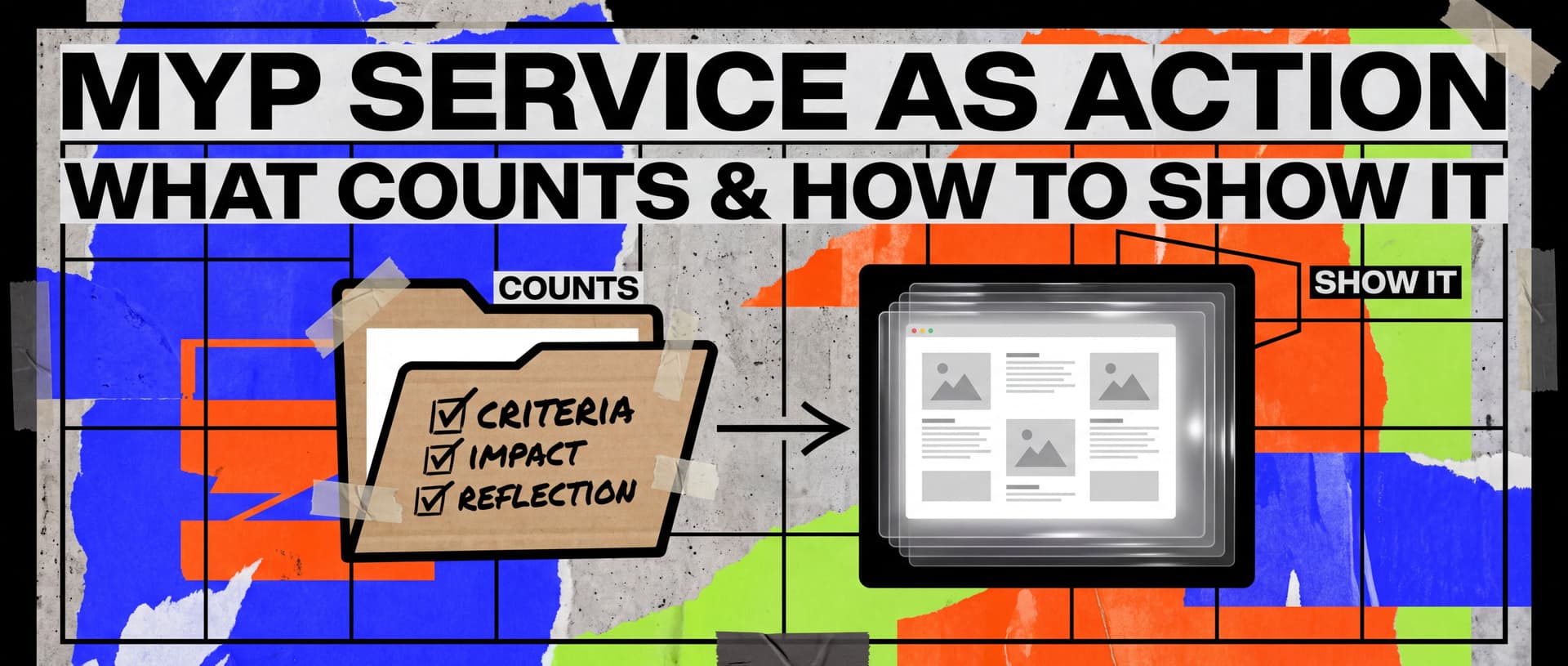
What Counts as MYP Service as Action?
Begin with a need that the community recognises. The IB’s MYP principles and practice guide emphasises checking the need with the people concerned and respecting their dignity and independence.
Before choosing an activity, ask:
- Who has identified the need, and what have they said would help?
- What will I contribute personally?
- How will I find out whether the action was useful?
- What could I learn or improve through doing it?
An existing school initiative can provide a starting point. Find out what still needs doing and agree on a role you can carry through. A clearly defined role in an existing project can make a worthwhile contribution.
The IB’s further guidance on Service as Action also allows opportunities beyond particular subject units, including independent and family community service.
Treat fundraising, awareness campaigns and volunteering as activities to examine in context. Explain the need, your involvement and what you learned. A donation receipt or an attendance certificate alone cannot explain all three.
The same test helps with doubtful cases. Enjoying a hobby or attending an event does not automatically establish service. Identify the contribution to others and discuss it with your school before presenting the activity as Service as Action.
Service as Action Examples From IB Schools
Published IB accounts show that service can take different forms.
In an account by MYP educator Novadene Miller, MYP 4 and 5 students developed a workshop about gender equality for younger pupils. They used artwork and discussion to help the children explore the issue. The same account describes an MYP 2 awareness initiative involving charity fundraising and collaboration with a school in Jamaica.
A 2026 IB report on MYP projects describes students creating an illustrated children’s book to raise awareness of wetland conservation through their community project.
These examples offer possible directions: teaching, communicating an issue, creating a useful resource or organising support. Their relevance depends on the need in your setting.
Before borrowing an idea, establish who would use the workshop, resource or support. Ask what they already have and what would improve it. That conversation gives your project a clearer purpose and gives you something specific to evaluate later.
The Seven MYP Service as Action Learning Outcomes
The IB’s MYP principles and practice guide, page 24 sets out seven learning outcomes. Here they are paraphrased in plain language:
- Recognise strengths and growth needs. Identify what you do well and what you need to improve.
- Build skills through challenge. Develop abilities by taking on something that stretches you.
- Plan action initiated by students. Discuss options, assess their value and help design the activity.
- Sustain your effort. Continue working when difficulties arise or plans need adjusting.
- Collaborate effectively. Share responsibility and contribute to work with other people.
- Broaden your international outlook. Engage with global issues, different languages and cultural perspectives.
- Consider ethics. Examine the consequences of your decisions and whether your actions are responsible.
The IB’s further guidance explains that these outcomes develop across the programme. Students are not expected to demonstrate every outcome in every activity or document all seven each year.
For a particular reflection, choose the outcomes your experience actually supports. Explain the connection through a decision, challenge, interaction or change in your understanding. Review the wider pattern with your teacher over time.
Schools participating in the IB’s MYP enhancement trial may use draft community engagement guidance. Confirm which framework your school is using.
How Many Service Hours Do MYP Students Need?
The IB’s further guidance states:
“The IB does not set specific requirements regarding the number of hours students must devote to community service.”
Its current MYP grading and awards guidance requires certificate candidates to meet their school’s expectations for participation in Service as Action.
Ask your school about approval, participation, recording and review. If it requests dates or time spent, provide them accurately. Also explain what you contributed and learned, because a total cannot show those things on its own.
For planning, choose a commitment you can sustain alongside your other responsibilities. Agree on realistic tasks and communicate early if circumstances change. Reliable follow through gives you a stronger basis for reflection than promising work you cannot complete.
Service as Action, the Community Project and CAS
These terms describe related learning, but their requirements differ.
Service as Action is part of the MYP’s approach to applying learning and contributing to communities.
The MYP community project is a structured project focused on community needs and service learning. The IB’s projects guidance says students completing the MYP in Year 3 or Year 4 complete it. Students completing the programme in Year 5 undertake the personal project. The endpoint of the school’s programme matters here.
Schools offering the full five year MYP may also choose to offer a community project. Completing one does not automatically fulfil all school expectations for Service as Action.
The personal project has a broader focus on an individual interest and learning. For its separate structure, see our MYP Personal Project Guide.
Creativity, Activity, Service, or CAS, belongs to the Diploma Programme core. The IB’s CAS guidance describes its own strands, learning outcomes and project requirement. Apply your MYP school’s framework when completing MYP service.
Planning, collaboration and reflection provide useful preparation for later CAS. Treat that connection as preparation for future learning, without assuming that an MYP activity fulfils a DP requirement.
Record Evidence Without Creating Another Homework Task
The IB recommends a manageable recording process that helps students reflect on growth and receive feedback. Our practical suggestion is to keep a brief entry at a meaningful stage of the activity, supported by evidence that helps explain it.
Use your school’s required format. If it gives you flexibility, the following structure can keep an entry focused:
| Part of the record | What to include |
|---|---|
| Activity and date | What you worked on and when |
| Community need | The need and how you checked it |
| My contribution | Your decisions, responsibilities and actions |
| Evidence | A relevant plan, resource, work sample or feedback |
| Learning | The outcome you developed and what shows it |
| Next step | What you will continue, change or investigate |
This is Koncepts’ suggested recording format; use your school’s instructions for required submissions.
Choose evidence for what it demonstrates. A resource you produced can show your contribution. Feedback can help explain a revision. A dated plan can show how you organised the work.
For group activities, identify your part clearly. Give teammates credit for their work and explain where decisions were shared.
Keep records as the activity develops. Add a short note after a significant decision or useful feedback, while the details are still clear. An ongoing record should help you think about the next step, as well as explain the experience afterwards.
Write Reflections That Show Learning
A useful question from RevisionDojo’s DP CAS guide is:
“Who benefits, and how do I know?”
Although written for CAS, this also works as a practical reflection prompt for MYP service. It asks you to connect an intention with evidence.
Build your reflection around a specific moment:
- What did I initially think would help?
- What did I learn from the people involved?
- Which decision or difficulty mattered?
- What does the evidence show about my contribution?
- What would I change next time?
Describe limits honestly. If you produced a resource but do not yet know how it was used, say so and identify the feedback you still need. If an approach did not work, explain what you changed and why.
When linking to a learning outcome, name the action that supports your claim. Explain how you shared responsibility, developed a skill or reconsidered a decision. Specific details make the learning easier for you and your teacher to discuss.
Choose a Purposeful Next Step
Start by speaking to your teacher or service coordinator about a community need you want to understand. Agree on a manageable contribution and find out what your school expects you to record.
Then follow through, listen to feedback and keep evidence that helps explain your learning. Review what the experience suggests about your next opportunity to contribute.
For subject learning that can inform those ideas, explore Koncepts for MYP students. Use what you are studying to ask better questions about the communities around you.
Related Blogs
Table of contents
Share
Related reading
- How Hard Is the IB? MYP & DP DifficultyDiscover how hard the IB really is, from MYP workload to the toughest DP subjects. Compare the challenges and assess your IB readiness with Koncepts now.
- MYP vs IGCSE: Differences, Difficulty & ChoiceCompare MYP vs IGCSE, understand key differences, difficulty, and IBDP readiness. Find the best fit for your child and make a confident choice today.
- Is Your PYP Exhibition Truly Student-Led? A Complete Guide to Agency, Inquiry and Action ( Detailed )Learn how to make the PYP Exhibition truly student-led with practical guidance on agency, inquiry design, mentor roles, action, assessment and reflection.
