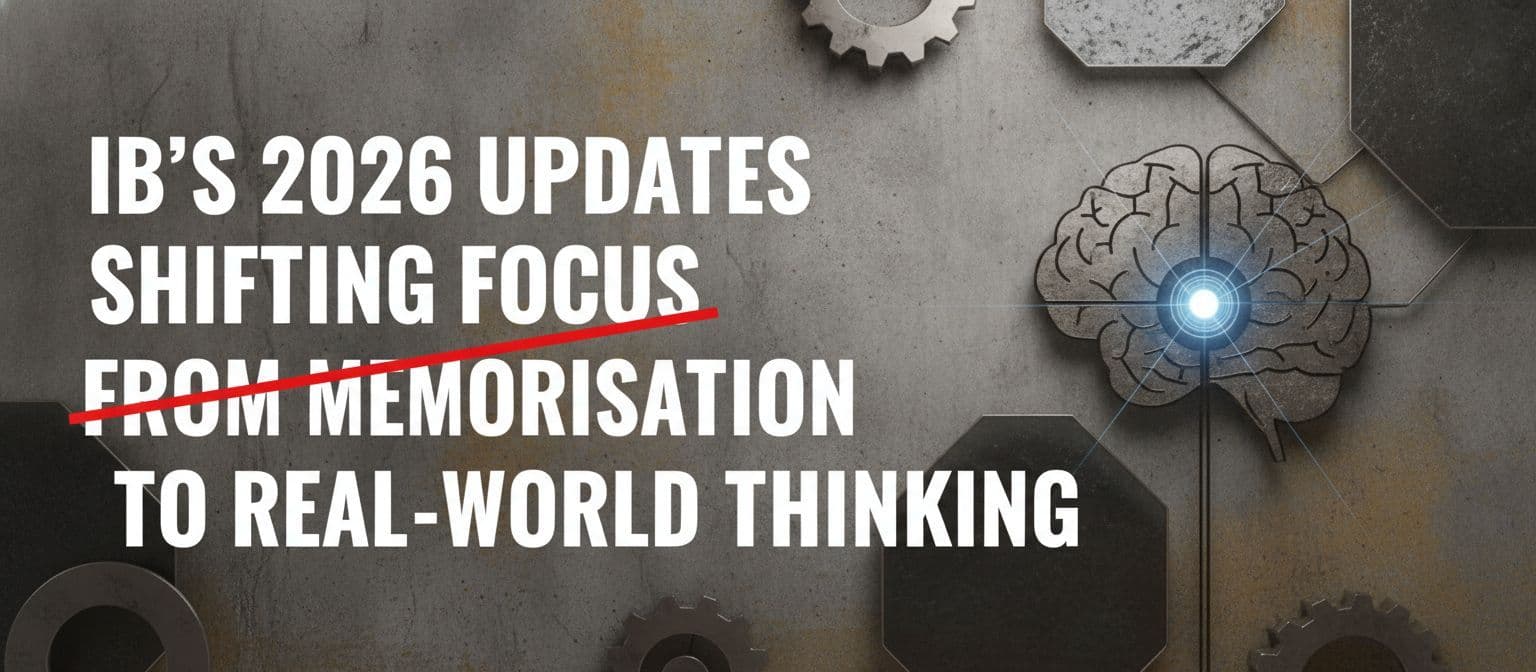
A New Era for International Education
For decades, one criticism has followed traditional education systems around the world: students often become experts at memorising information without necessarily understanding how to apply it. High scores have frequently rewarded recall, repetition, and test taking techniques more than genuine understanding and critical thinking.
The International Baccalaureate has long positioned itself as an alternative to this approach. Its emphasis on inquiry, interdisciplinary learning, and conceptual understanding has attracted educators and families seeking a broader educational experience. However, the educational landscape continues to evolve rapidly. Universities, employers, and societies increasingly value adaptability, problem solving, creativity, and real world application over simple content retention.
In response to these changing expectations, the International Baccalaureate's updates for 2026 signal an important shift. While the IB has always championed critical thinking, the latest developments strengthen its commitment to moving away from memorisation and toward authentic learning experiences.
For students, parents, and educators, understanding this transition is essential because it reflects not just a change in assessment methods, but a broader redefinition of what educational success truly means.
Why Memorisation Is Losing Its Importance
Memorisation has always played a role in education. Foundational knowledge remains important in every discipline, from mathematics and sciences to literature and history. However, modern educational research consistently demonstrates that memorising information alone rarely leads to deep understanding.
In today's world, information is more accessible than ever. Students can retrieve facts instantly through digital tools and artificial intelligence platforms. Consequently, the ability to simply recall information has become less valuable than the ability to analyze, evaluate, synthesize, and apply that information effectively.
Educational institutions worldwide increasingly recognize that future success depends on skills such as:
- Critical thinking
- Problem solving
- Communication
- Collaboration
- Adaptability
- Creativity
- Ethical reasoning
The IB's 2026 updates reflect this reality by placing greater emphasis on these competencies throughout the learning process.
Understanding the Philosophy Behind the 2026 Updates
The changes introduced by the International Baccalaureate are not sudden or isolated decisions. They represent the continuation of a long term educational philosophy that prioritizes inquiry driven learning.
At its core, the IB believes that education should prepare students not merely to pass examinations but to engage meaningfully with complex global challenges.
The world students enter today differs dramatically from the world their parents experienced. Rapid technological advancement, global interconnectedness, climate challenges, geopolitical shifts, and emerging industries require individuals who can think independently and adapt continuously.
The 2026 updates strengthen several existing principles:
- Conceptual understanding over factual recall
- Application over repetition
- Inquiry over passive learning
- Analysis over memorisation
- Reflection over mechanical performance
These principles align closely with the demands of higher education and modern careers.
Greater Emphasis on Real World Contexts
One of the most noticeable shifts involves the increased focus on applying knowledge within authentic contexts.
Rather than asking students to simply reproduce definitions or formulas, assessments increasingly encourage learners to explore how concepts operate in real world situations.
For example, science students may analyze contemporary environmental challenges. Economics students may evaluate current global economic trends. Literature students may examine how texts reflect societal issues and human experiences.
This approach serves several purposes.
First, it improves engagement. Students often learn more effectively when they understand the practical relevance of what they are studying.
Second, it develops transferable skills. Real world problems rarely fit neatly within one subject area, requiring students to integrate knowledge from multiple disciplines.
Finally, it better prepares students for university and professional environments, where problem solving and critical analysis are highly valued.
Conceptual Learning Is Becoming More Important
Conceptual understanding has always been a defining characteristic of the IB curriculum, but the 2026 developments place even greater importance on this approach.
Instead of asking students to memorize isolated facts, conceptual learning encourages them to identify broader principles and connections.
For instance:
- A history student explores patterns of power, conflict, and change.
- A biology student examines systems, relationships, and adaptation.
- A mathematics student investigates underlying structures and logical reasoning.
- A literature student analyzes themes, perspectives, and cultural contexts.
This method transforms learning from a process of information accumulation into a process of understanding relationships and developing insight.
Students who grasp concepts deeply are also better equipped to transfer knowledge across disciplines and unfamiliar situations.
Assessment Methods Are Evolving
Perhaps the most significant impact of the 2026 updates concerns assessment.
Traditional examinations often reward speed, memorization, and procedural repetition. While examinations remain important within the IB framework, there is a growing emphasis on evaluating higher order thinking skills.
Assessment increasingly focuses on:
- Analytical reasoning
- Evaluation of evidence
- Problem solving
- Interpretation
- Reflection
- Communication skills
- Application of knowledge
This shift changes how students should prepare.
Success no longer depends primarily on memorizing large volumes of information. Instead, students must learn how to think critically, construct arguments, evaluate evidence, and communicate their ideas effectively.
In many ways, this mirrors the expectations students will encounter at leading universities worldwide.
Interdisciplinary Thinking Is Receiving Greater Attention
One of the defining characteristics of modern problems is that they rarely belong to a single discipline.
Climate change involves science, economics, politics, ethics, and geography.
Artificial intelligence involves computer science, philosophy, law, psychology, and business.
Public health involves medicine, sociology, economics, and policy.
The IB's educational philosophy increasingly reflects this interconnected reality.
Students are encouraged to make connections across subjects, identify relationships between ideas, and approach problems from multiple perspectives.
This interdisciplinary mindset develops intellectual flexibility, one of the most valuable skills in the twenty first century.
Rather than viewing subjects as isolated categories, students learn to see knowledge as an interconnected system.
The Role of Artificial Intelligence in Educational Change
The rapid advancement of artificial intelligence has accelerated discussions about the future of education.
When information retrieval becomes instantaneous, educational institutions must reconsider what students truly need to learn.
The answer is increasingly clear.
Students must develop skills that machines cannot easily replicate, including:
- Critical judgment
- Creativity
- Ethical reasoning
- Complex problem solving
- Human communication
- Contextual understanding
The IB's 2026 updates reflect this reality by emphasizing cognitive skills that extend beyond factual recall.
This does not mean that knowledge becomes irrelevant. Instead, knowledge serves as the foundation upon which deeper thinking skills are built.
The objective shifts from remembering information to using information intelligently.
What This Means for Students
For students currently enrolled in the IB program or planning to pursue it, these changes require a shift in mindset.
Traditional study strategies centered around memorization may become less effective.
Instead, students should focus on:
Asking Better Questions
Strong learners develop curiosity. They seek to understand why concepts matter rather than simply memorizing what they are.
Building Conceptual Connections
Students should actively identify relationships between topics, subjects, and real world situations.
Practicing Analysis
Developing analytical skills requires regular practice. Students should engage with case studies, discussions, essays, and problem solving exercises.
Reflecting on Learning
Reflection helps transform information into understanding. Students should regularly evaluate what they know, how they learned it, and where they can improve.
Applying Knowledge
The ability to transfer knowledge across contexts increasingly determines academic success.
What Parents Need to Understand
Parents often associate academic excellence with traditional indicators such as memorization, repetition, and examination performance.
However, educational success is evolving.
The skills most likely to determine future success include adaptability, critical thinking, collaboration, and creativity.
This means parents may need to adjust their expectations regarding study habits and academic achievement.
A student spending time on research projects, collaborative discussions, reflective writing, or interdisciplinary investigations is not necessarily studying less rigorously. In many cases, they are developing more sophisticated intellectual abilities.
Supporting curiosity and independent thinking may become just as important as encouraging academic discipline.
What Educators Must Adapt To
Teachers play a crucial role in facilitating this transition.
The move toward real world thinking requires educators to shift from serving primarily as information providers to becoming learning facilitators.
This involves:
- Encouraging inquiry
- Designing authentic learning experiences
- Promoting discussion and debate
- Supporting reflection
- Facilitating interdisciplinary connections
- Developing higher order thinking skills
Teaching becomes less about delivering content and more about guiding students through increasingly complex intellectual challenges.
While this transition presents challenges, it also creates opportunities for more meaningful and engaging educational experiences.
The Future of Educational Success
The International Baccalaureate's 2026 updates reflect a broader transformation occurring across global education systems.
The question is no longer how much information students can memorize.
Instead, the question becomes:
Can students think critically?
Can they solve unfamiliar problems?
Can they apply knowledge effectively?
Can they adapt to changing circumstances?
Can they understand complex global issues?
These abilities increasingly define educational and professional success.
Final Thoughts
The International Baccalaureate's 2026 updates represent more than a curriculum revision. They reflect a fundamental shift in how educational achievement is understood.
Memorisation is not disappearing entirely, nor should it. Foundational knowledge remains essential. However, the emphasis is moving decisively toward understanding, application, critical thinking, and real world engagement.
For students, this shift presents an opportunity to develop skills that extend far beyond examinations.
For educators, it creates a chance to foster deeper and more meaningful learning.
For parents, it offers a reminder that success in the modern world requires more than strong memory skills.
As education continues to evolve, one principle becomes increasingly clear: the future belongs not to those who remember the most information, but to those who know how to use knowledge to understand and shape the world around them.
Table of contents
Share
Related reading
- The IB Boom Is Reshaping Classrooms Worldwide in 2026Explore why the IB is expanding in 2026 and how rising enrolment is reshaping standards, competition, teacher workload, and classroom practice worldwide.
- Will the IB Diploma Still Be Worth Choosing in 2030?Will the IB Diploma be worth it in 2030? Explore its future value, university recognition, costs, global reach, and who should choose it. Read before deciding
- IB Digital Exams: What Changes and When for StudentsDiscover when IB digital exams begin, which subjects go online first, and how to prepare with this complete student friendly timeline and guide.
- IB Digital Exams: What Really Changes When Paper Disappears?Worried about IB digital exams? Discover what really changes, what stays the same, and how to prepare smarter for online assessments.
- The IB Classroom Secret That Lowers Stress and Boosts SuccessResearch-backed ways IB teachers can reduce student anxiety, improve communication and build a healthier classroom without lowering standards.
