Introduction
Choosing between Mathematics Analysis and Approaches (Math AA) and Mathematics Applications and Interpretation (Math AI) is one of the most important academic decisions an International Baccalaureate student will make. This choice is not simply about selecting a mathematics course. It can influence university admissions, career opportunities, academic confidence, and overall performance in the IB Diploma Programme.
Many students assume that Math AA is only for brilliant mathematicians while Math AI is the easier option. In reality, both subjects are rigorous, valuable, and designed for different learning styles and career aspirations. The best choice depends on your strengths, interests, and future goals rather than perceived difficulty.
This guide explains the key differences between Math AA and Math AI, who should choose each course, and how students can make a confident and informed decision.
Understanding the Two Mathematics Pathways
The IB introduced two distinct mathematics courses to better reflect the diverse needs of students worldwide.
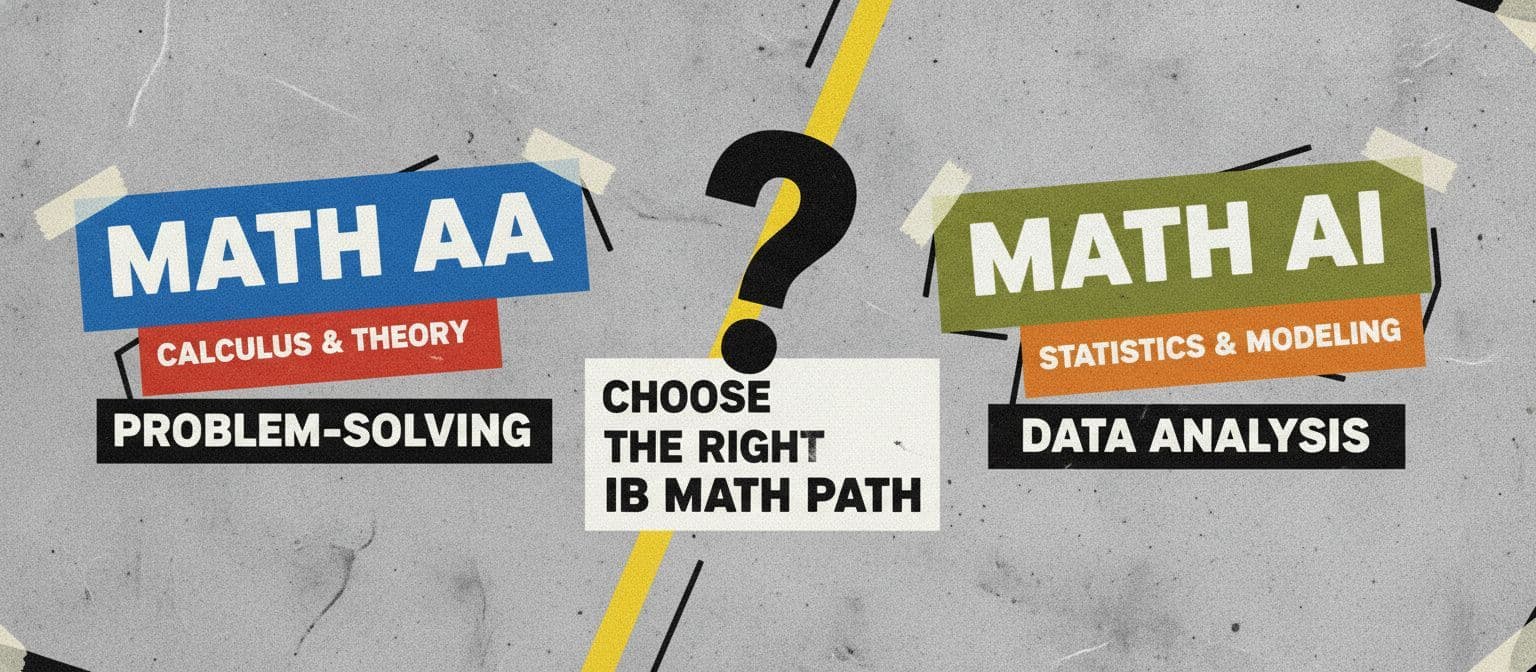
Mathematics Analysis and Approaches focuses on traditional mathematical thinking. Students spend considerable time exploring algebra, calculus, functions, proofs, and abstract problem solving. The course emphasizes mathematical reasoning and analytical thinking.
Mathematics Applications and Interpretation takes a more practical approach. Students learn how mathematics is applied in real world situations through statistics, probability, technology, financial mathematics, and mathematical modeling. The course encourages students to interpret data and solve practical problems using digital tools.
Neither course is superior to the other. They simply prepare students for different academic and professional pathways.
What Makes Math AA Different?
Math AA is designed for students who enjoy solving challenging mathematical problems and understanding why mathematical concepts work.
The course places significant emphasis on algebraic manipulation, calculus, trigonometry, functions, and mathematical proofs. Students often solve complex equations without relying heavily on technology and are expected to demonstrate detailed mathematical reasoning.
Students who enjoy finding patterns, proving formulas, and working through challenging calculations often feel comfortable in Math AA.
This pathway develops strong logical thinking and prepares students for mathematically intensive university programs.
What Makes Math AI Different?
Math AI emphasizes applying mathematics to real life situations.
Students explore statistical analysis, data interpretation, probability, financial mathematics, optimization, and mathematical modeling. Technology plays a much larger role, allowing students to analyze data, visualize results, and solve practical problems efficiently.
Rather than focusing only on abstract theory, Math AI encourages students to understand how mathematics influences economics, business, social sciences, environmental studies, and technology.
Students who enjoy interpreting graphs, analyzing trends, and using mathematics to solve everyday problems often thrive in this course.
Higher Level and Standard Level Options
Both Math AA and Math AI are available at Higher Level and Standard Level.
Higher Level courses involve greater depth, increased complexity, and a faster learning pace. Students choosing Higher Level mathematics should be prepared for a substantial workload throughout the IB Diploma Programme.
Standard Level courses provide a balanced mathematical foundation while allowing students to dedicate additional time to other IB subjects.
Selecting the correct level is just as important as selecting the correct course.
Which Students Should Choose Math AA?
Math AA is generally suitable for students planning careers in fields such as engineering, physics, mathematics, computer science, architecture, economics at highly quantitative universities, and certain branches of data science.
Students who usually perform well in algebra and enjoy solving theoretical mathematical problems often find this course rewarding.
However, choosing Math AA simply because it appears more prestigious can become a mistake if it does not match a student's interests or strengths.
Which Students Should Choose Math AI?
Math AI is often an excellent choice for students interested in business, psychology, environmental sciences, design, communications, hospitality, social sciences, health sciences, and many interdisciplinary fields.
The course develops valuable analytical skills through practical applications rather than purely theoretical mathematics.
Many universities fully recognize Math AI for a wide range of degree programs, although some highly mathematical courses may specifically require Math AA.
Students should always verify university requirements before making a final decision.
Common Misconceptions
One of the biggest myths is that Math AI is an easy course.
This is far from true.
Math AI demands strong analytical thinking, careful interpretation of data, and effective use of technology. Students must understand mathematical concepts deeply enough to apply them in unfamiliar situations.
Another misconception is that every ambitious student should choose Math AA.
The reality is that success in the IB often comes from selecting subjects that align with personal strengths. Excelling in Math AI may be more beneficial than struggling unnecessarily in Math AA.
Universities appreciate students who perform well in appropriate subjects rather than students who choose difficult courses without achieving strong results.
Questions Every Student Should Ask
Before selecting a mathematics pathway, students should reflect honestly on several important questions.
Do I enjoy abstract mathematics or practical problem solving?
Am I comfortable with algebra and calculus?
Do I prefer working with statistics and data?
Which university courses am I considering?
What are the mathematics entry requirements for those programs?
Which subject matches my learning style?
Answering these questions can make the decision much clearer.
The Role of Parents and Teachers
Parents and teachers play an important role in helping students make informed decisions.
Instead of encouraging students to choose the course that appears more prestigious, they should focus on long term success.
Teachers understand a student's mathematical abilities, classroom performance, and learning habits. Their recommendations often provide valuable insight.
Parents can support the decision by discussing future career goals and encouraging students to research university requirements well in advance.
A collaborative approach usually leads to better academic outcomes.
University Admissions Matter
Different universities have different expectations.
Many engineering, mathematics, and physics programs strongly recommend or require Math AA, particularly at Higher Level.
Other programs, including business, psychology, environmental science, and humanities, often accept both Math AA and Math AI, depending on the institution.
Because admission policies vary across countries and universities, students should carefully review official entry requirements before making their final subject selections.
Making assumptions can limit future opportunities.
Final Thoughts
Choosing between Math AA and Math AI is not about selecting the harder subject. It is about selecting the right subject.
Students who understand their interests, learning style, and future aspirations are more likely to succeed throughout the IB Diploma Programme.
Both mathematics pathways develop valuable analytical skills that prepare students for higher education and future careers. The key is choosing the course that complements your academic goals rather than following common myths or peer pressure.
A thoughtful decision today can build confidence, improve academic performance, and create stronger opportunities for university admission tomorrow.
Table of contents
Share
Related reading
- Math AA or Math AI? Choose Right for University SuccessConfused between Math AA and Math AI? Discover which IB math course matches your university goals, career plans, and admission requirements for 2027.
- IB Math 2027 Changes: What Every Student Must KnowDiscover the latest IB Math AA and AI updates for 2027. Learn what changes are coming, who is affected, and how to prepare with confidence today.
- IB Math Is Changing for 2027: What Year 1 Students Must Know TodayIB Math AA and AI are changing for 2027. Learn what current Year 1 students must know now to prepare smarter and avoid costly mistakes.
- IB Extended Essay Is Changing in 2027: Choose the Right PathDiscover the new IB Extended Essay pathways from 2027. Compare Subject Focused and Interdisciplinary options to choose the best fit for your goals.
- Math IA Topic Ideas by Syllabus Area (AA & AI)Discover high scoring IB Math IA topics for AA and AI, sorted by syllabus area, with scoring tips, topic warnings, and smarter ideas. Start planning today.
