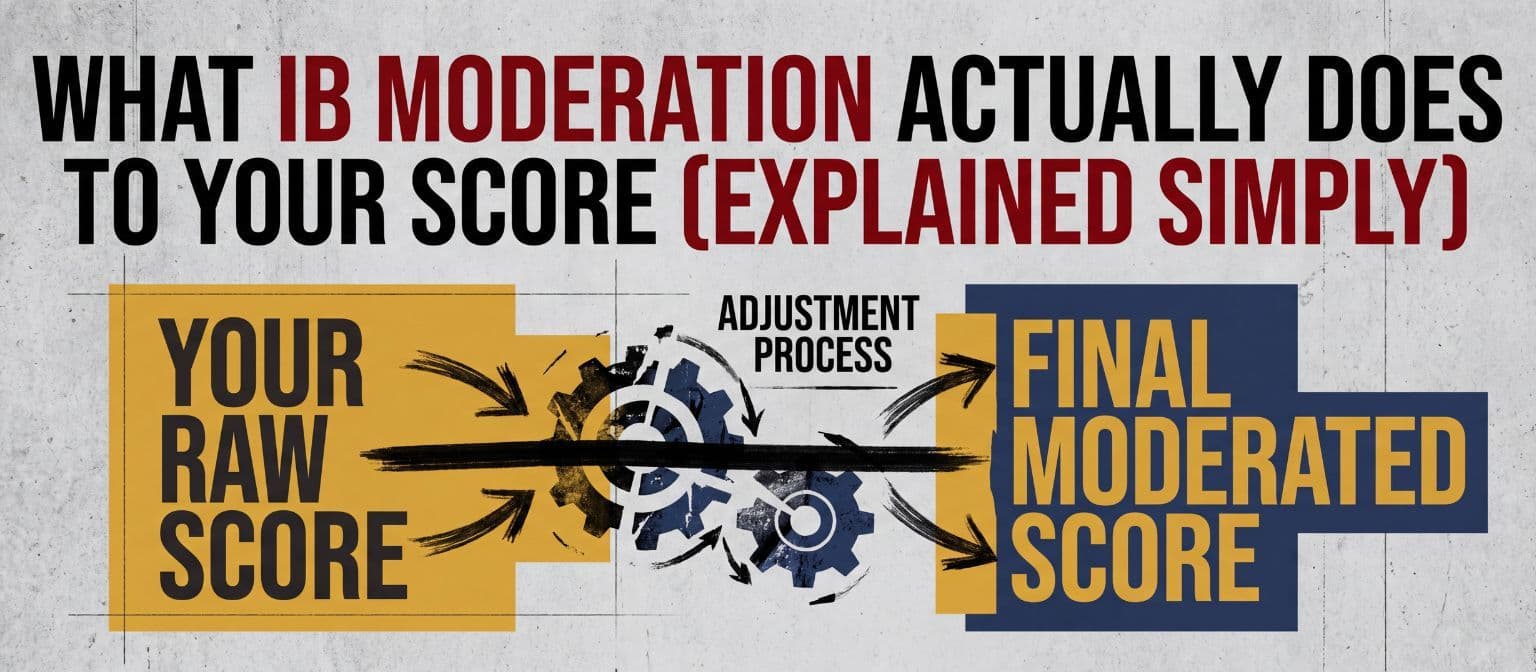
Introduction: The Part of the IB That Most Students Misunderstand
For many International Baccalaureate students, results day can feel confusing.
You open your grades expecting to see a direct reflection of the marks your teacher awarded throughout the year. Instead, you may discover that your final score is different from what you anticipated. Perhaps your Internal Assessment score increased. Perhaps it dropped. Sometimes an entire class experiences similar changes.
This process often leads students to ask an important question: "What exactly happened to my score?"
The answer usually lies in one of the least understood parts of the International Baccalaureate assessment system: moderation.
Many students hear about moderation but never fully understand what it does. Some believe moderators carefully review every student's work. Others think moderation exists to make exams harder or to reduce grades. Neither assumption is entirely correct.
Understanding moderation is important because it affects millions of IB students worldwide every year. More importantly, understanding how it works can help students prepare more effectively and avoid unnecessary stress.
This guide explains IB moderation in simple terms, including why it exists, how it works, and what it can actually do to your final score.
What Is IB Moderation?
At its core, moderation is a quality control process.
The International Baccalaureate operates in thousands of schools across hundreds of countries. Since Internal Assessments are graded by teachers rather than external examiners, the IB needs a way to ensure that grading standards remain consistent worldwide.
Imagine two students completing identical Internal Assessments in different countries. Without moderation, one teacher might award a score of 18 out of 20 while another teacher awards 14 out of 20 for work of similar quality.
Moderation exists to prevent these inconsistencies.
The goal of moderation is not to punish students or lower grades. Instead, it aims to ensure that students receive fair and consistent marks regardless of where they study.
Why Doesn't the IB Just Grade Everything Itself?
This is one of the most common questions students ask.
The simple answer is scale.
Every year, hundreds of thousands of IB students submit Internal Assessments across dozens of subjects. Individually grading every experiment, oral presentation, portfolio, essay, and investigation would require an enormous number of examiners and significantly increase costs and processing time.
Teachers play a crucial role because they work closely with students throughout the course and can evaluate assignments according to IB criteria.
However, because teachers are human, grading standards naturally vary.
Some teachers grade generously.
Some grade strictly.
Some fall somewhere in between.
Moderation helps correct these differences while preserving the benefits of teacher assessment.
How Does IB Moderation Actually Work?
The moderation process is surprisingly systematic.
After teachers assess Internal Assessments, schools submit a sample of student work to the IB. This sample typically includes work representing a range of performance levels.
IB examiners then review these samples independently.
The examiner compares the teacher's marks with what they believe the marks should be according to official IB criteria.
Three main outcomes are possible.
The Teacher's Marking Is Accurate
If the examiner determines that the teacher's grading aligns closely with IB standards, no adjustment is made.
In this situation, students keep the marks originally assigned by their teacher.
The Teacher Has Been Too Generous
If the examiner finds that the teacher consistently awarded marks that are too high, the IB may reduce marks for the entire class.
This adjustment ensures that students are evaluated according to global standards rather than local grading practices.
The Teacher Has Been Too Strict
Moderation can also work in the student's favor.
If the examiner concludes that the teacher graded too harshly, marks may increase across the class.
This aspect of moderation is often overlooked because students usually focus only on the possibility of losing marks.
Does the IB Read Every Student's Internal Assessment?
In most cases, no.
This is perhaps the biggest misconception about moderation.
Typically, moderators review a representative sample rather than every submission from every student.
Based on the findings from that sample, adjustments may then be applied to the entire group.
This approach allows the IB to maintain consistency while managing the enormous volume of assessments submitted each year.
However, this also means that your final moderated score can be affected by the overall accuracy of your teacher's marking.
Why Can an Entire Class Gain or Lose Marks?
Many students find this aspect frustrating.
Imagine a teacher consistently awards marks that are approximately three points higher than official IB standards. If moderators identify this pattern, the IB may adjust the entire class downward by a similar amount.
The opposite can also happen.
If a teacher consistently grades below IB standards, the entire class may benefit from an upward adjustment.
The IB uses statistical methods and expert judgment to ensure these adjustments reflect systematic patterns rather than isolated differences.
The goal is fairness at a global level, even if the outcome feels surprising at an individual level.
Does Moderation Affect Every Subject?
Not all subjects use moderation in exactly the same way.
Several subjects include internally assessed components that undergo moderation. Examples include:
- Sciences
- Mathematics
- Economics
- Geography
- History
- Language courses
- Visual Arts
- Theory of Knowledge
However, the specific moderation process can vary depending on the assessment structure.
For example, some subjects involve uploaded coursework, while others may involve recordings, portfolios, or teacher assessed performances.
The fundamental purpose remains the same: ensuring consistency across schools worldwide.
Can Moderation Cause Large Score Changes?
In some cases, yes.
Although many moderated adjustments are relatively small, larger changes can occur.
For example:
- A score of 18 out of 20 might become 16 out of 20.
- A score of 12 out of 20 might increase to 14 out of 20.
- An adjustment could potentially affect the final subject grade boundary.
Even a small change in Internal Assessment marks can influence a student's overall diploma score, particularly when grade boundaries are close.
This is why students sometimes experience unexpected final results despite receiving encouraging feedback during the academic year.
Does Moderation Mean Teachers Cannot Be Trusted?
Absolutely not.
Moderation is not designed because teachers are untrustworthy.
In fact, most IB teachers work extremely hard to apply assessment criteria accurately.
However, perfect consistency across thousands of schools and educators is nearly impossible.
Consider sports judging.
Even experienced judges may interpret performances slightly differently. Standardization processes help ensure fairness across competitions.
IB moderation functions in much the same way.
It supports teachers by ensuring that all students worldwide are assessed according to the same standards.
What Can Students Learn From Moderation?
One important lesson is that predicted grades and classroom marks should be viewed carefully.
Students sometimes become overly confident because they received strong Internal Assessment feedback from their teacher.
Others become discouraged because they believe their teacher graded too harshly.
Moderation means that neither situation guarantees the final outcome.
Instead of focusing exclusively on teacher awarded marks, students should prioritize:
- Understanding official assessment criteria.
- Reviewing examiner reports.
- Studying mark schemes.
- Analyzing high scoring examples.
- Seeking feedback aligned with IB standards.
The closer your work matches official expectations, the less surprising moderation becomes.
Can Students Appeal Moderated Scores?
The IB does provide mechanisms for reviewing results.
Students can request services such as re marking of externally assessed components and certain administrative checks.
However, moderation itself is generally not appealed in the same way that individual exam papers can be reviewed.
This is because moderation reflects a systematic evaluation process rather than a judgment on a single student's assignment.
Schools can sometimes request additional reviews under specific circumstances, but these situations are relatively uncommon.
Should Students Worry About Moderation?
The short answer is no.
Moderation is not something students can control directly.
Worrying about whether marks will increase or decrease rarely provides any benefit.
Instead, students should focus on the factors they can influence:
- Producing high quality work.
- Following assessment criteria carefully.
- Incorporating teacher feedback effectively.
- Reviewing exemplar responses.
- Demonstrating clear understanding and analysis.
Strong work generally remains strong work, regardless of moderation.
The Real Purpose of Moderation
The word "moderation" often creates anxiety because students associate it with losing marks.
But that perspective misses the bigger picture.
Imagine a world without moderation.
Students in schools with generous grading practices would gain unfair advantages. Students in stricter schools would be unfairly penalized. University admissions decisions would become less reliable, and the value of the IB diploma would weaken.
Moderation exists to protect the integrity of the qualification.
Its purpose is not to make students' lives harder.
Its purpose is to ensure that a score earned in one country means the same thing as a score earned anywhere else in the world.
Final Thoughts
IB moderation remains one of the most misunderstood parts of the diploma programme.
Many students imagine mysterious examiners changing grades behind the scenes. In reality, moderation is a carefully designed process intended to maintain fairness and consistency across a global education system.
Yes, moderation can change your score.
Yes, it can occasionally be frustrating.
But it can also work in your favor, and more importantly, it helps ensure that every student's achievement is measured according to the same international standard.
The best strategy is not to fear moderation.
The best strategy is to understand it.
Because once you understand how moderation actually works, it becomes far less mysterious and far more manageable.
Table of contents
Share
Related reading
- Stop Chasing IA Deadlines: A Two Year Plan That WorksA practical two-year IA timeline that builds student ownership, reduces deadline stress, improves Internal Assessment quality and saves teachers time.
- IB Results Appeal Guide: When to Fight Final MarksLearn when to appeal your IB results, how reviews work, key risks, deadlines, and smart next steps before you challenge your final marks with confidence.
- NECM Results Could Change Your University Plans in the UAELearn how NECM results could affect IB students in the UAE and Middle East. Understand university admissions and take the right steps before deadlines.
- The IB Psychology IA Changed Forever in 2027: What Students Must KnowThe IB Psychology IA changed completely for 2027. Discover what replaced the experiment write up and how to prepare for top marks.
- IB Internal Assessment Mistakes Students Must AvoidAvoid common IB IA mistakes that cost marks. Learn proven strategies to improve structure, analysis, and scores. Read now and boost your IA performance.
