Introduction
Artificial intelligence is no longer a distant idea in education. It is already helping students explain concepts, organise research, test arguments, improve language, and prepare for assessments.
For an IB student, however, the most important question is not whether artificial intelligence should be used. The real question is what role it plays in the learning process.
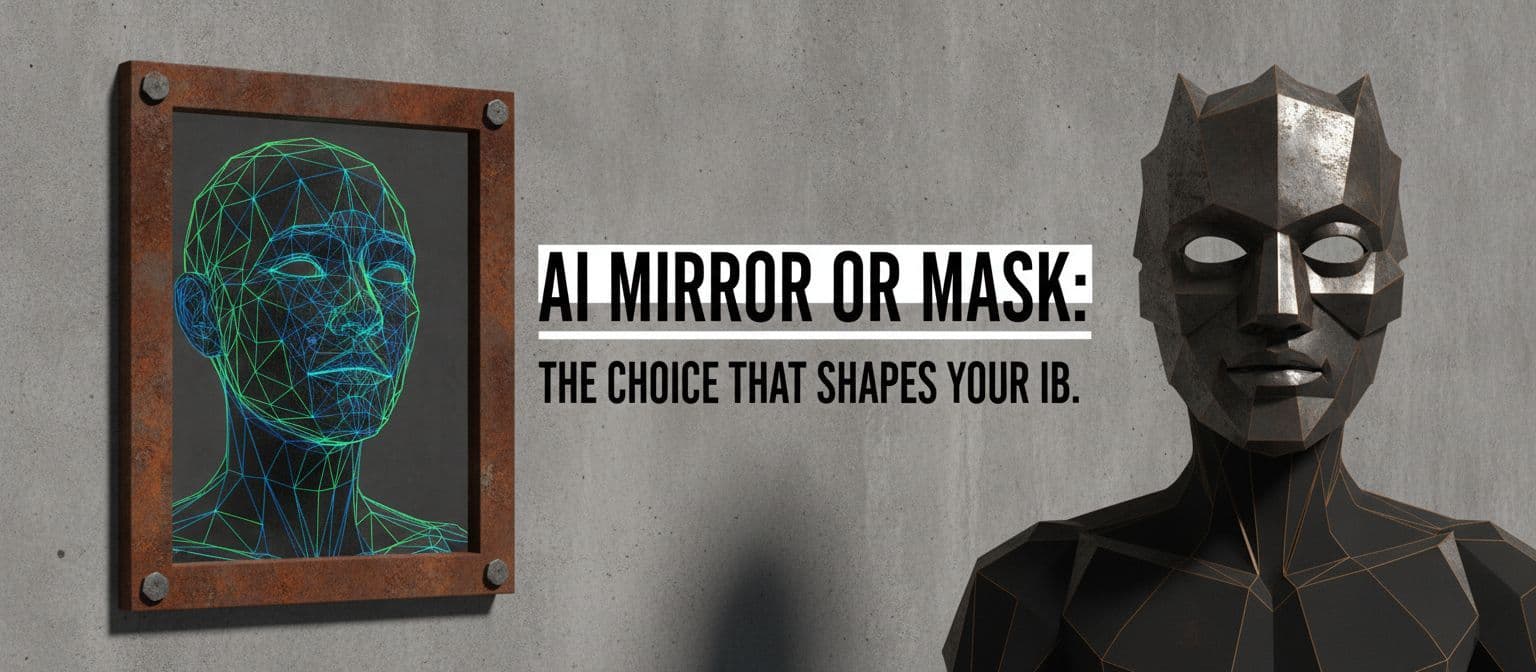
Used responsibly, artificial intelligence becomes a mirror. It reflects weaknesses in an argument, exposes gaps in understanding, challenges assumptions, and helps a student communicate ideas with greater clarity.
Used irresponsibly, it becomes a mask. It hides who completed the thinking, disguises a lack of understanding, and presents machine produced work as evidence of a student’s own ability.
The difference between these two uses may appear small. A student may begin by asking for help and end by submitting words, ideas, or analysis that they cannot independently explain. Yet this difference can influence assessment results, academic integrity decisions, university readiness, and the value of the IB Diploma itself.
The IB does not treat artificial intelligence as something that must simply be banned. Its position is that these tools can support learning, but students must still submit genuine and authentic work that represents their own abilities. Material created by artificial intelligence cannot automatically be treated as the student’s original work.
Understanding the difference between support and substitution is therefore one of the most important academic skills an IB student can develop.
What It Means to Use AI as a Mirror
A mirror does not replace the person standing in front of it. It helps that person see something more clearly.
Artificial intelligence works as a mirror when it helps students examine their own thinking. The student remains responsible for the question, interpretation, argument, evidence, judgement, and final expression.
Consider a student writing a History essay. They may ask an artificial intelligence tool to identify assumptions within their argument. The tool may point out that the essay relies too heavily on one perspective or does not clearly distinguish between short term and long term causes.
The student must then decide whether that criticism is valid. They must return to their evidence, reconsider the argument, and rewrite the section themselves.
The thinking remains with the student.
The same principle applies to Mathematics, Biology, Economics, Literature, Theory of Knowledge, and the Extended Essay. Artificial intelligence can ask questions, reveal confusion, simulate feedback, or offer alternative ways to approach a problem.
It becomes educationally valuable when it increases the amount of thinking a student performs.
What It Means to Use AI as a Mask
A mask hides what is underneath.
Artificial intelligence becomes a mask when a student uses it to create the appearance of knowledge without developing the knowledge itself.
This happens when a student submits an argument they did not construct, an analysis they cannot defend, or language that does not reflect their actual ability.
For example, a student may ask artificial intelligence to write an entire English essay and then modify a few words before submitting it. The final version may appear polished, but the intellectual work does not belong to the student.
Another student may use artificial intelligence to generate an Extended Essay research question, structure, argument, evidence, analysis, conclusion, and reflection. Even if the student combines several outputs, the final work may still fail to represent independent research and judgement.
The mask may work temporarily. A teacher may not immediately recognise every artificial intelligence contribution. However, IB assessment is not based only on elegant sentences.
Teachers and examiners look for conceptual understanding, relevant evidence, consistent reasoning, personal engagement, reflection, methodological awareness, and the ability to justify choices.
When the submitted work is stronger than the student’s actual understanding, inconsistencies begin to appear. The student may struggle to explain a claim, defend a method, identify the source of an idea, or reproduce the same quality under supervised conditions.
The mask eventually becomes visible.
Why the IB Focuses on Authentic Work
The IB is built around inquiry, reflection, communication, independent judgement, and academic integrity.
These principles require students to take responsibility for their own learning. Assessment is intended to show what the student understands and can do.
If artificial intelligence performs the central intellectual task, the assessment no longer measures the student accurately.
This is why the issue is larger than plagiarism detection. The core concern is authenticity.
A piece of work can contain original wording and still be academically dishonest if the reasoning, structure, or interpretation was produced by someone or something else and presented as the student’s own contribution.
Similarly, the absence of copied sentences does not automatically prove that the work is authentic.
Students must ask a deeper question.
Does this submission honestly represent my own abilities?
The IB expects students to take credit only for their own work and to recognise contributions from other sources. Its current approach accepts that artificial intelligence will remain part of education while maintaining that ethical use must protect genuine learning.
Five Safe Uses of AI for IB Students
1. Testing Your Understanding
One of the safest uses of artificial intelligence is asking it to test what you already know.
After studying cellular respiration, for example, a Biology student can ask for questions that move from basic recall to application and evaluation.
The student should answer without copying material from the tool. Artificial intelligence can then identify incomplete explanations or misconceptions.
This approach is useful because it turns passive revision into active retrieval.
The student is not asking the tool to demonstrate understanding on their behalf. They are using it to check whether their own understanding is strong enough.
A useful prompt might ask the tool to behave like a demanding teacher, present one question at a time, and challenge vague answers.
2. Finding Gaps in an Argument
Artificial intelligence can be used to question an argument that the student has already developed.
A Theory of Knowledge student might provide a claim and ask what assumptions it contains. An Economics student might ask which stakeholders have been overlooked. A History student might ask whether the argument confuses correlation with causation.
The value comes from the challenge, not the answer.
Students should never accept every criticism automatically. Artificial intelligence can misunderstand the subject, invent weaknesses, or recommend changes that do not match the assessment criteria.
The student must judge the feedback and decide what deserves revision.
This preserves intellectual ownership.
3. Improving Clarity Without Changing Meaning
Students may use artificial intelligence to identify unclear sentences, repetition, weak transitions, or unnecessary complexity.
The safest approach is to ask for a diagnosis rather than a replacement.
Instead of saying, “Rewrite this paragraph,” a student can ask, “Which sentences are unclear, and why?”
The student can then revise the paragraph independently.
This distinction matters. Asking for a complete rewrite can replace the student’s voice with machine produced language. Asking for areas of confusion helps the student improve their own communication.
The final wording should still sound like the student and remain within their genuine language ability.
4. Creating Practice Questions
Artificial intelligence can generate additional practice questions based on a topic, concept, command term, or assessment objective.
A student preparing for Psychology might request questions that require explanation, application, and evaluation. A Mathematics student might ask for problems testing the same skill at increasing levels of difficulty.
These questions should be used for practice, not assumed to be accurate replicas of official examination material.
Students should compare them with the syllabus, teacher guidance, and authentic assessment formats.
Used carefully, this method can expand revision opportunities without replacing learning.
5. Planning a Study Process
Artificial intelligence can help students divide large academic tasks into smaller steps.
For an Internal Assessment, it might help create a schedule for choosing a topic, collecting data, drafting sections, receiving teacher feedback, revising, checking citations, and completing the final submission.
The tool can support organisation, but it should not make the academic decisions.
The student must still choose the question, understand the method, conduct the investigation, interpret the evidence, and justify the conclusion.
Planning assistance is safe when it improves discipline rather than outsourcing judgement.
Five AI Uses That Put Your Diploma at Risk
1. Submitting AI Written Work as Your Own
The clearest danger is submitting machine produced text, images, graphs, calculations, or analysis without appropriate acknowledgement.
Changing a few words does not transform the material into original work.
The central issue is authorship. If artificial intelligence created a meaningful part of the submission, the student cannot honestly claim full ownership.
Students must follow their school’s academic integrity policy and the specific guidance provided for each assessment.
2. Using AI to Produce the Main Argument
An essay is not merely a collection of sentences. Its main academic value lies in the argument.
If artificial intelligence decides the thesis, selects the reasoning, arranges the claims, and produces the conclusion, it has completed much of the intellectual task.
A student may rewrite the output in different language and still fail the authenticity test.
Brainstorming possible directions can support thinking. Allowing the tool to determine the final argument replaces thinking.
3. Inventing Evidence, Sources, or Data
Artificial intelligence tools can produce incorrect quotations, false publication details, fabricated statistics, and sources that do not exist.
Using such information can damage both academic integrity and academic quality.
Every source must be located, read, understood, and verified by the student. A citation is not valid simply because an artificial intelligence tool presented it convincingly.
This is especially important in the Extended Essay, Internal Assessments, research projects, and Theory of Knowledge work.
A polished falsehood remains false.
4. Creating Reflections You Did Not Experience
IB reflections are meant to show the development of the student’s thinking.
Artificial intelligence cannot genuinely describe what surprised the student, why a method changed, which difficulty affected the investigation, or how the student’s understanding developed.
A machine can produce language that sounds reflective, but it cannot supply authentic personal engagement.
Submitting artificial reflection turns an important record of learning into performance.
Students should write reflections from their own notes, decisions, mistakes, and discoveries.
5. Depending on AI Until You Cannot Work Alone
The most dangerous misuse may not involve a single dishonest submission.
It is the gradual loss of independence.
A student who uses artificial intelligence for every introduction, explanation, outline, calculation, interpretation, and conclusion may begin to feel incapable of starting without it.
This dependence becomes visible during examinations, oral discussions, teacher conferences, presentations, and university work.
The IB Diploma is not only a final score. It is preparation for tasks where students must think under pressure, defend choices, conduct research, and communicate independently.
A tool that constantly removes difficulty may also remove growth.
A Simple Test Before Using AI
Before using artificial intelligence for any IB task, students can apply five questions.
Did I attempt the task myself first?
Starting independently reveals what the student actually knows and where support is needed.
Is the tool helping me think or thinking for me?
If the tool is producing the central argument, interpretation, or judgement, the student is moving towards substitution.
Can I explain every idea in my final work?
A student should be able to defend each claim, method, calculation, source, and conclusion.
Have I verified the information?
Artificial intelligence output should never be treated as automatically accurate.
Would I be comfortable showing my teacher exactly how I used it?
If the answer is no, the use is probably crossing an academic integrity boundary.
How Schools and Teachers May Differ
The IB provides broad principles, but individual schools may establish more detailed rules for artificial intelligence use.
One teacher may allow artificial intelligence for practice questions but not for feedback on an assessed draft. Another may permit language support if it is documented. Certain assessments may have stricter conditions than ordinary classroom tasks.
Students should therefore avoid assuming that a use is acceptable simply because it seems harmless.
Before using artificial intelligence in assessed work, they should check the school policy, assessment instructions, subject guidance, and teacher expectations.
When uncertain, students should disclose the intended use before proceeding.
Transparency is safer than trying to interpret the rules privately after the work has been completed.
Why Responsible AI Use Can Improve IB Performance
Responsible use does not weaken student independence. It can strengthen it.
When artificial intelligence exposes a vague explanation, the student learns to communicate precisely. When it challenges an assumption, the student learns to evaluate more carefully. When it creates practice questions, the student gains more opportunities to retrieve knowledge.
In each case, the tool increases the student’s intellectual effort.
This is the standard IB students should aim for.
The best use of artificial intelligence should leave the student more capable of working without it.
After a productive session, the student should understand the concept more deeply, recognise weaknesses more quickly, and make stronger decisions independently.
If the student becomes less confident without the tool, the relationship has moved in the wrong direction.
Conclusion
Artificial intelligence does not automatically threaten the IB Diploma. The danger comes from using it to hide the absence of genuine learning.
As a mirror, artificial intelligence can reveal weaknesses, test understanding, challenge arguments, support revision, and sharpen communication.
As a mask, it can conceal who produced the ideas, replace independent judgement, fabricate evidence, and create work the student cannot defend.
The difference is not determined by the tool. It is determined by the student’s choices.
IB students do not need to avoid artificial intelligence completely. They need to use it in a way that protects ownership, honesty, and intellectual independence.
The safest principle is simple.
Use artificial intelligence to improve your thinking, never to impersonate it.
Table of contents
Share
Related reading
- Talk About AI Without Losing Your Students’ TrustLearn how to discuss AI with IB students in a way that builds trust, encourages responsible use, and strengthens academic integrity in every classroom.
- IB AI Rules Decoded: What You Can Actually UseConfused about IB AI rules? Learn what AI is actually allowed for in EE, IA, and TOK, avoid academic misconduct, and use AI the right way.
- AI in the IB Classroom 2026: Rules Every Student Must KnowDiscover what AI use is allowed in the IB Classroom in 2026, avoid academic misconduct, and learn to use AI responsibly for better results.
- IB Students Are Panicking About AI Detection. Here's the TruthWorried about using AI in IB? Learn what examiners can actually detect, how AI policies work, and how to use AI safely and ethically.
- Using AI in Your IB IA? Here's How to Stay Safe and Score HigherLearn how to use AI ethically in your IB Internal Assessment, avoid academic misconduct risks, and improve your IA scores confidently.
